What is the Standard 3rd Grade? Age vs Grade Guide
Quick Answer The standard age for 3rd grade in the United States is 8 to 9 years old. Most children reach third grade after progressing through kindergarten (age 5–6) and the early elementary years on a typical one-grade-per-year schedule. This range represents the widely accepted “standard” across U.S. public schools, shaped by state kindergarten entry cutoff dates. While individual circumstances can create variations, the 8–9 age window is the benchmark that guides curriculum design, developmental expectations, and classroom planning in the majority of American elementary schools.
Introduction
Parents, teachers, and caregivers often seek clarity on the standard 3rd grade age because it directly influences everything from academic expectations and social dynamics to decisions about readiness, retention, or enrichment. Understanding what constitutes the “standard” helps families set realistic goals, recognize when a child is thriving within (or outside) typical parameters, and advocate effectively for their child’s needs.
Third grade is widely regarded as a pivotal year — the point where students shift from “learning to read” to “reading to learn.” It is also when many states introduce more formal standardized assessments and when peer relationships and independence become increasingly important.
This guide provides a comprehensive, evidence-based look at the standard 3rd grade age, how it is determined, why variations occur, what developmental and academic milestones are expected at this stage, and practical strategies for supporting children whether they fall squarely within the standard range or slightly outside it. Drawing from classroom experience, developmental research, and authoritative educational sources, the goal is to deliver genuinely useful information that empowers readers.
What Is the Standard 3rd Grade Age in the US?
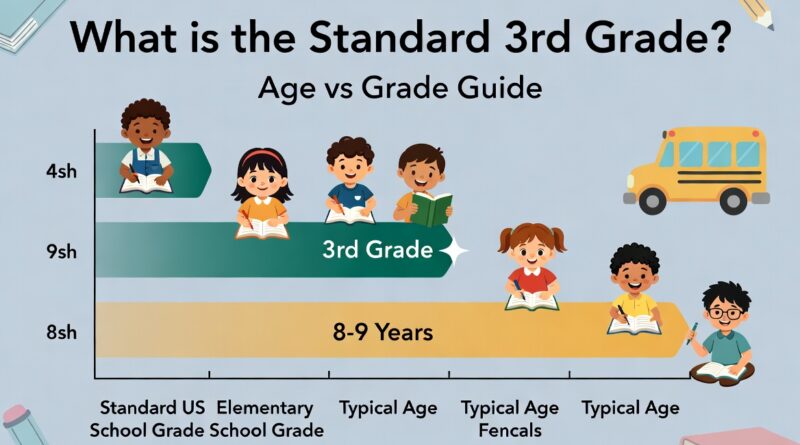
In the United States, the standard age for third graders is 8 to 9 years old. This is not an arbitrary number but the natural outcome of the conventional K-12 progression combined with state-mandated kindergarten entry ages.
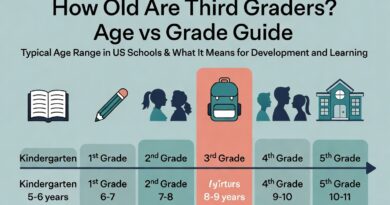
Here is the typical age-to-grade progression used across most U.S. elementary schools:
| Grade Level | Typical Age at Start of Year | Age During the School Year |
|---|---|---|
| Kindergarten | 5 years | 5–6 years |
| 1st Grade | 6 years | 6–7 years |
| 2nd Grade | 7 years | 7–8 years |
| 3rd Grade | 8 years | 8–9 years |
| 4th Grade | 9 years | 9–10 years |
| 5th Grade | 10 years | 10–11 years |
This standard emerges because the majority of states require children to be 5 years old by a specific cutoff date (most commonly September 1 or August 31) to enter kindergarten. Three years later, those same children are 8 turning 9 during third grade.
The National Center for Education Statistics (NCES) and state education departments consistently reference this age-grade alignment when reporting enrollment data and setting instructional standards.
Also Read: How Old Are Students in Each Grade? Age-by-Grade Chart
How the “Standard” Is Established: Cutoff Dates, Policy, and Progression
The standard 3rd grade age is the product of deliberate policy decisions at the state and district levels rather than a universal biological milestone.
Kindergarten entry cutoffs are the foundation. As of recent data:
- Approximately 32 states use a September 1 cutoff.
- Others use August 31, August 1, or October 1.
- A small number of states or districts retain flexibility or have recently adjusted dates (for example, Ohio’s recent shift toward earlier cutoffs for the 2026–2027 school year).
Because third grade sits three years after kindergarten entry, these cutoffs create the consistent 8–9 year window for the vast majority of students. A child born on August 15 in a September 1 cutoff state will typically start kindergarten at age 5 and enter third grade at age 8. A child born on September 15 will usually start kindergarten the following year and enter third grade at age 8 turning 9.
This system creates predictability for schools when designing curriculum, ordering materials, and planning professional development. It also allows teachers to prepare for a relatively narrow developmental band — though, as any experienced educator knows, even within the standard 8–9 range there is meaningful variation in maturity, reading level, and social skills.
Variations from the Standard 3rd Grade Age: Why They Happen and What They Mean
While 8–9 is the standard, real classrooms contain students both younger and older than this range. Common reasons include:
- Redshirting: Parents delay kindergarten entry for children with late summer birthdays or perceived immaturity. This produces older third graders (often 9 turning 10).
- Grade retention: Repeating a year due to academic, social, or developmental concerns results in older students.
- Acceleration: Highly advanced learners may skip a grade, entering third grade at 7 turning 8.
- Homeschooling, private schools, or mid-year transfers: Placement decisions are sometimes based on assessment rather than strict age.
- Special education considerations: IEPs prioritize developmental readiness and may result in non-standard age placement.
In my experience teaching third grade, I worked with students who were chronologically 7 (accelerated) and others who were 10 (retained or redshirted). The key lesson was that age alone did not predict success. Some of the youngest students were among the most capable readers and leaders, while some older students needed targeted support with executive function and peer relationships. The “standard” age provides a useful reference point, but it is never the whole story.
Research on the relative age effect shows that being among the youngest or oldest in a class can influence confidence, participation in sports, and initial academic comparisons — though high-quality, differentiated instruction significantly reduces long-term disparities.
Developmental Expectations in the Standard 3rd Grade (Ages 8–9)
Third grade aligns with the heart of Piaget’s concrete operational stage (roughly 7–11 years). Children in this stage develop stronger logical thinking, understand reversibility, and begin to see situations from multiple perspectives — skills that underpin third-grade reading comprehension, multi-step math, and collaborative projects.
Key developmental milestones typical for the standard 8–9 age range include:
Physical Improved coordination, stamina for longer physical activity, better fine motor control for writing and detailed work, and growing independence in self-care.
Cognitive & Academic Ability to understand cause-and-effect, plan ahead, sustain attention on engaging tasks for 30–45+ minutes, grasp reverse operations in math, and begin collecting hobbies with real depth.
Language & Literacy Transition to fluent “reading to learn,” rapid vocabulary growth through reading, enjoyment of wordplay and jokes, and ability to summarize, discuss, and write about texts with increasing structure.
Social-Emotional Stronger peer orientation, desire to belong to groups, emerging perspective-taking, fluctuating self-esteem that benefits from encouragement, and greater emotional self-regulation (though mood swings remain common).
These milestones are drawn from frameworks used by organizations such as Understood.org and align with what experienced third-grade teachers observe daily.
Also Read: How Old Are Third Graders? Age vs Grade Guide
What Students Learn in a Standard 3rd Grade Classroom
Curriculum in the standard 3rd grade builds directly on second-grade foundations while raising expectations for independence and complexity.
English Language Arts Students read longer chapter books, make inferences, identify themes, compare texts, and write multi-paragraph opinion, narrative, and informational pieces. The shift to reading across content areas begins in earnest.
Mathematics Mastery of multiplication and division facts, multi-digit operations with regrouping, introduction to fractions, measurement, and geometry. Word problems require more reasoning and persistence.
Science & Social Studies Deeper exploration of ecosystems, forces, communities, government, and map skills. Students conduct simple experiments and research projects.
Social-Emotional & Work Habits Emphasis on collaboration, time management, self-advocacy, and growth mindset. Many schools introduce more consistent homework routines.
These expectations are guided by state standards (frequently aligned with Common Core) and are designed with the typical 8–9 year old in mind. Excellent teachers differentiate so that students slightly younger or older than the standard can still access grade-level content with appropriate support or challenge.
Pros and Cons of Being “On Standard” Age vs. Variations
Advantages of the standard 8–9 range
- Curriculum and pacing are generally well-matched to developmental readiness.
- Peer group is relatively homogeneous in age and experience.
- Easier access to age-appropriate extracurriculars and social activities.
Potential challenges even within the standard
- Some 8-year-olds may still be consolidating reading fluency while others are devouring chapter books.
- Social-emotional maturity can vary widely even among same-age peers.
For younger-than-standard students Pros: Often intellectually advanced; may develop strong work habits early. Cons: May feel physically or socially smaller; can experience frustration if expectations feel overwhelming without support.
For older-than-standard students Pros: Often more mature, physically bigger, and able to take on leadership roles. Cons: May feel bored if not challenged; risk of social mismatch or lowered self-perception if retained.
Transparent communication between parents and teachers is the best way to navigate any of these scenarios.
Practical Tips for Supporting Children in or Near the Standard 3rd Grade
For Parents
- Read aloud or alongside your child daily — even 15–20 minutes of engaging chapter books makes a measurable difference.
- Turn math facts into games rather than timed drills.
- Build routines that foster independence (homework station, nightly backpack check).
- Talk openly about emotions and problem-solve social situations together.
For Teachers and Schools
- Use formative assessment early and often to identify where students are within the broad 8–9 developmental band.
- Provide differentiated texts, math tasks, and extension opportunities.
- Maintain regular, two-way communication with families about both academic progress and social-emotional well-being.
When to Seek Additional Support Persistent difficulties with reading fluency, math fact automaticity, attention, or peer relationships especially when affecting confidence warrant a conversation with the teacher and possibly a school psychologist or learning specialist.
Conclusion
The standard 3rd grade age of 8 to 9 years old provides a useful and widely applied benchmark for curriculum, instruction, and developmental expectations across U.S. schools. It reflects thoughtful policy decisions about when formal schooling begins and how children progress through the system.
Yet the most important insight from years of classroom practice and research is this: while the standard offers a helpful reference, children are not standardized. Within any third-grade classroom — whether students are exactly 8, turning 9, or slightly outside that range — there will always be meaningful differences in readiness, learning pace, and social-emotional needs.
The goal for parents and educators is not to force every child into an identical timeline, but to understand the standard deeply enough to recognize when a child is thriving within it, when they need extra support or challenge, and how to partner effectively to help each student grow. With clear information, open communication, and a focus on the whole child, third grade can be a year of genuine excitement, confidence-building, and meaningful academic progress exactly as it should be.
FAQs About the Standard 3rd Grade Age
What exactly is the standard age for 3rd grade?
8 to 9 years old is the widely accepted standard range in U.S. public schools, resulting from typical kindergarten entry at age 5 and annual grade progression.
Can a 7-year-old be in 3rd grade?
It is uncommon in traditional public settings but possible through acceleration or in some private/homeschool environments after careful evaluation.
What if my child is 9 or 10 in 3rd grade?
This can happen due to redshirting, retention, or late birthday relative to cutoff. Many older third graders thrive with appropriate challenge and leadership opportunities.
How do state cutoff dates affect the standard age?
They are the primary driver. Most states use a September 1 or similar cutoff, creating the consistent 8–9 window three years later.
Does being slightly younger or older than the standard matter long-term?
Research on relative age effects shows short-term differences in some areas, but high-quality teaching and supportive environments tend to equalize outcomes over time.
How can I tell if my child is ready for the academic demands of standard 3rd grade?
Look at reading fluency, ability to follow multi-step directions, attention span on school-like tasks, and emotional regulation. Your child’s current teacher and school assessments are the best guides.
Are private schools more flexible with age placement?
Many are, though most still reference similar age bands. Always ask about their specific policies during the admissions process.
What resources provide reliable information on 3rd grade expectations?
The National Center for Education Statistics (nces.ed.gov), your state department of education website, Understood.org, and direct conversations with your child’s teacher are excellent starting points.
Should I consider holding my child back or accelerating them?
These are significant decisions best made collaboratively with educators using multiple data points academic performance, developmental assessments, and observations of the whole child.
How has the pandemic affected what “standard” looks like in 3rd grade?
Many cohorts experienced disrupted learning, leading to greater variation in readiness within classrooms. Schools have responded with increased emphasis on differentiation, social-emotional support, and targeted intervention.