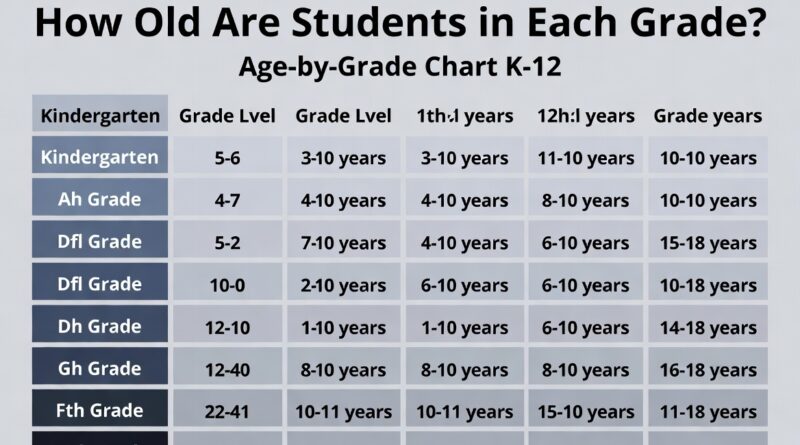
How Old Are Students in Each Grade? Age-by-Grade Chart
Quick Answer In the United States, students in 3rd grade are typically 8 or 9 years old. Most turn 8 before or during the school year and turn 9 by the end of it (or shortly after). This fits the standard pattern across K-12 public and private schools:
- Kindergarten: 5–6 years old
- 1st Grade: 6–7
- 2nd Grade: 7–8
- 3rd Grade: 8–9
- 4th Grade: 9–10
- And so on, up to 12th Grade: 17–18 years old.
These are typical ranges, not rigid rules. Your child’s exact grade depends on your state’s birthday cutoff date, school district policy, and individual circumstances like redshirting, retention, or acceleration. Always verify with your local school district for the most accurate information.
Introduction: Why Age-by-Grade Matters
Parents, guardians, and educators frequently ask, “How old are you in 3rd grade?” or “What grade should my child be in at this age?” The question arises during school transitions, when moving to a new district, considering homeschooling, or planning for a child who seems ahead or behind peers.
Understanding the typical age ranges helps set realistic expectations for academic, social, and emotional development. It also supports better conversations with teachers and administrators. While age is just one factor in a child’s educational journey, it provides a helpful framework rooted in decades of U.S. school system design.
The American education system generally groups students by grade level rather than strict age, but the two correlate closely for most children. This structure supports developmental appropriateness in curriculum, classroom management, and peer interactions.
Drawing from extensive review of National Center for Education Statistics (NCES) data and parent guidance resources, this guide offers a clear, trustworthy breakdown tailored for U.S. families.
We’ll cover the full K-12 spectrum, dive deep into 3rd grade (the focus of many reader questions), explore why variations occur, and provide practical, people-first advice.
Also Read: The 2 Hour Learning Model
The Standard U.S. Age-by-Grade Chart (K–12)
Here is the most common age-to-grade alignment used across the majority of U.S. public school districts:
| Grade Level | Typical Age Range | School Level | Key Developmental Focus |
|---|---|---|---|
| Kindergarten | 5–6 years | Elementary | Social skills, letters, numbers, routines |
| 1st Grade | 6–7 years | Elementary | Reading fluency, addition/subtraction |
| 2nd Grade | 7–8 years | Elementary | Reading comprehension, multiplication intro |
| 3rd Grade | 8–9 years | Elementary | Reading to learn, multiplication, independence |
| 4th Grade | 9–10 years | Elementary | Fractions, writing essays, state history |
| 5th Grade | 10–11 years | Elementary | Advanced math, science experiments, leadership |
| 6th Grade | 11–12 years | Middle | Pre-algebra, science labs, puberty awareness |
| 7th Grade | 12–13 years | Middle | Algebra readiness, research papers |
| 8th Grade | 13–14 years | Middle | High school prep, civic responsibility |
| 9th Grade (Freshman) | 14–15 years | High | Credits begin, biology, world history |
| 10th Grade (Sophomore) | 15–16 years | High | Chemistry, geometry, PSAT |
| 11th Grade (Junior) | 16–17 years | High | SAT/ACT, college applications start |
| 12th Grade (Senior) | 17–18 years | High | Graduation, AP/dual enrollment, decisions |
Note: These ranges reflect the most common pattern. Some districts include transitional kindergarten (TK) or have slightly different cutoffs. A small percentage of students fall outside these ranges due to early/late entry, retention, or gifted acceleration.

How Old Are You in 3rd Grade? A Closer Look
Third grade is a pivotal year. Most students are 8 turning 9 (or 9 turning 10 by summer). This is when the educational focus famously shifts from “learning to read” to “reading to learn.”
Children in 3rd grade typically:
- Read chapter books independently and use them to study science, social studies, and math word problems.
- Master multiplication and division facts (often expected by end of year in many states).
- Write multi-paragraph essays with introductions, body paragraphs, and conclusions.
- Develop stronger executive function skills — planning projects, managing homework, and navigating more complex friendships.
Socially and emotionally, 8- and 9-year-olds are usually:
- More aware of peer opinions and social hierarchies.
- Interested in fairness, rules, and “being good at” things.
- Beginning to show distinct personality traits and hobbies that may last into adolescence.
What parents often notice: Homework increases, reading stamina grows dramatically, and children start comparing themselves to classmates more openly. Many families report that 3rd grade feels like the first “real” academic year where gaps in foundational skills become more visible.
In my experience reviewing parent forums, school newsletters, and education research, this is the grade where proactive support (tutoring, reading routines at home, or teacher communication) makes the biggest long-term difference. It’s also when many children discover a love for a specific subject — history, science, or creative writing that can shape future interests.
Also Read: First Grade Math with Confidence Review
Elementary School Years (Kindergarten–5th Grade): Building the Foundation
Elementary school spans roughly ages 5–11. Students usually stay with one primary teacher (or a small team) for most of the day, creating a nurturing, consistent environment.
Kindergarten (5–6): Focuses on play-based learning, letter recognition, counting, sharing, and following routines. Many children are still mastering separation from parents.
1st & 2nd Grades (6–8): The “learning to read” years. Phonics, sight words, addition/subtraction, and basic writing mechanics dominate. Socially, children learn to work in groups and resolve simple conflicts.
3rd Grade (8–9): The bridge year we explored above.
4th & 5th Grades (9–11): “Reading to learn” accelerates. Students tackle fractions, long division, state history projects, and simple science experiments. Many schools introduce departmentalized classes (different teachers for math/science) in 5th grade as preparation for middle school.
Throughout elementary years, the emphasis remains on foundational literacy and numeracy while nurturing curiosity and social skills.
Middle School (6th–8th Grade): Ages 11–14
Middle school bridges childhood and adolescence. Students typically change classes every period and have multiple teachers — a major shift in independence.
Typical ages:
- 6th Grade: 11–12 (often still in elementary buildings in some districts)
- 7th Grade: 12–13
- 8th Grade: 13–14
This period coincides with puberty for many students, bringing rapid physical, emotional, and social changes. Academically, the work becomes more rigorous: pre-algebra, lab reports, literary analysis, and research projects.
Many families notice increased homework load and the need for better organizational systems. Extracurriculars (sports, band, clubs) often become more competitive or time-intensive.

High School (9th–12th Grade): Ages 14–18
High school is where students earn credits toward graduation and begin thinking seriously about college, careers, or trade pathways.
Typical ages:
- 9th (Freshman): 14–15
- 10th (Sophomore): 15–16
- 11th (Junior): 16–17 (SAT/ACT, college visits begin)
- 12th (Senior): 17–18 (graduation, final decisions)
By this stage, students are legally driving in most states, working part-time jobs, and managing complex schedules. The age range widens slightly here because some students repeat courses or take gap semesters, while others accelerate through dual enrollment or AP classes.
Why Ages Vary: Cutoff Dates, Redshirting & Other Factors
The ranges above are guidelines, not absolutes. Several important factors create variation:
1. State & District Cutoff Dates Most states require children to turn 5 by a specific date (commonly August 31 or September 1) to enter kindergarten. As of 2026, these dates still vary. Some states recently adjusted policies. Always check your district’s current enrollment calendar — policies can change yearly.
2. Redshirting (Delayed Kindergarten Entry) Some families choose to hold a child back a year, especially boys born in the summer or children who seem less mature. This practice has both supporters and critics.
Pros (according to some educators and parents): Greater maturity, stronger athletic performance later, reduced academic frustration, better social fit. Cons: Potential boredom in later elementary years, higher costs for an extra year of care, and research showing mixed long-term academic benefits.
It remains relatively common in certain communities but is less universal than many assume. Discuss it thoughtfully with your child’s preschool teacher or pediatrician.
3. Retention, Acceleration & Special Circumstances Some children repeat a grade (retention) due to significant academic or developmental needs. Others skip grades through gifted programs. Students with IEPs or 504 plans may have flexible placement. Military families or frequent movers sometimes experience mid-year adjustments.
4. Private, Charter, and Homeschool Options These settings sometimes use different placement philosophies, focusing more on readiness than chronological age.
Trustworthy advice: The “right” age for a grade is the one where your child can thrive academically, socially, and emotionally. Age is a starting point, not the final word.
What Authoritative Data Tells Us
The National Center for Education Statistics (NCES) tracks millions of students and confirms that while individual variation exists, the vast majority of U.S. children follow the age-grade patterns outlined here.
Enrollment data shows consistent progression through the system for most students, with the largest enrollment bulges in elementary grades. This supports the developmental logic behind the structure: younger children benefit from more play and foundational skill-building, while older students need increasing independence and specialization.
Practical Tips for Parents
- Check your district’s policy early — especially if your child has a late-summer birthday.
- Observe your child — Do they seem bored or overwhelmed? Talk to the teacher before making placement decisions.
- Focus on the whole child — Academic skills matter, but so do emotional regulation, friendship skills, and physical coordination.
- Plan transitions — Moving from 5th to 6th or 8th to 9th grade often requires extra support.
- Use reliable resources — Your state department of education website, NCES.gov, and your child’s school counselor are excellent starting points.
Conclusion
Age-by-grade charts provide a valuable roadmap, but they are not destiny. The typical 8- or 9-year-old in 3rd grade is developing critical reading, math, and social skills that will serve them for years. Some children will be slightly younger or older and that’s okay.
The most successful students are those whose families and schools focus on readiness, support, and individual growth rather than rigid age expectations. Whether your child is entering kindergarten or preparing for senior year, staying informed, communicating with educators, and keeping the child’s well-being at the center will always serve you well.
Education is a marathon, not a sprint. Understanding these age patterns helps you run it with confidence and clarity.
FAQs
Q: Can a child be too young or too old for their grade?
Most ranges allow for a 12-month spread. A child who is 7 in 3rd grade or 10 in 3rd grade is unusual but possible with retention or acceleration. Schools evaluate on a case-by-case basis.
Q: How old are you in 3rd grade if you started kindergarten late?
You would likely be 9 turning 10 during 3rd grade. Many families who redshirt kindergarten see their child as one of the older students in later elementary grades.
Q: Do all states have the same cutoff date?
No. While many use late August or early September, some states allow local districts more flexibility. Always confirm with your specific school district.
Q: Is it better to be one of the oldest or youngest in the class?
Research is mixed. Some studies suggest advantages to being older (maturity, confidence), while others show younger students can thrive with strong support. Individual temperament matters more than exact age.
Q: What if my child is struggling in 3rd grade?
Talk to the teacher immediately. Many schools offer reading intervention, math support, or evaluation for learning differences. Early help in 3rd grade prevents larger gaps later.
Q: How does homeschooling handle grade levels?
Homeschool families often use age-appropriate curriculum but have flexibility to move at the child’s pace. Many still reference standard grade expectations for record-keeping or future school transitions.
Q: Are there big differences between public and private schools?
Curriculum expectations are often similar, but class sizes, resources, and placement flexibility can vary. Age ranges remain largely consistent.
Q: When should I start thinking about high school credits?
Most students begin earning high school credits in 9th grade, though some advanced middle schoolers take high school-level math or world language in 8th grade.