
10 Easy Christmas Games for Family Fun at Home
The holidays are a whirlwind of shopping lists, travel plans, and screen time that somehow multiplies. Yet the moments families remember most are rarely the perfectly wrapped gifts or elaborate meals. They are the spontaneous bursts of laughter when Grandpa tries to act out The Grinch, the friendly chaos of a living-room scavenger hunt, or the shared triumph when a team finally guesses the right Christmas song.
Research consistently shows that regular family play strengthens bonds, improves communication, and supports children’s emotional and academic development. In an era when many households juggle busy schedules, intentional screen-free activities become powerful tools for connection.
These 10 easy Christmas games were chosen because they require minimal supplies (mostly items already in your home), work for a wide range of ages and group sizes, and deliver maximum joy with very little stress. I have tested and refined every one of them across multiple holiday seasons with my own family and during gatherings I have hosted for friends and neighbor. Some nights we played just one game after dinner; other years we turned the entire evening into a mini tournament. The common thread? Everyone—from toddlers to grandparents ended up smiling, talking, and creating memories that lasted long after the tree came down.
Whether you live in a snowy Midwest farmhouse, a cozy urban apartment, or a sun-drenched West Coast home, these games adapt beautifully. They emphasize participation over perfection and laughter over winning.
Quick Answer: 10 Easy Christmas Games for Instant Family Fun
Here is your at-a-glance guide. Each game is described in one sentence so you can pick and start quickly:
- Christmas Charades — Act out holiday movies, songs, and characters without speaking while your team guesses.
- Christmas Bingo — Use picture or word cards featuring trees, Santas, and snowmen for a classic game everyone can win.
- Pin the Nose on Rudolph — Blindfolded players try to stick a red nose on a large Rudolph poster for silly, low-stakes fun.
- Indoor Christmas Scavenger Hunt — Follow clues or a list to find holiday items hidden around the house.
- Oven Mitt Gift Wrapping Race — Race to wrap (or unwrap) a gift while wearing oven mitts—guaranteed giggles.
- Christmas Trivia Challenge — Test movie plots, song lyrics, and fun facts in teams or individually.
- Jingle Bell Toss — Toss small jingle bells into cups or targets for active, skill-based competition.
- Christmas Pictionary — Draw holiday words and phrases while teammates guess before the timer runs out.
- Toilet Paper Snowman Challenge — Teams wrap one person in toilet paper and add paper accessories to create the best-looking snowman.
- Christmas Would You Rather — Answer lighthearted, silly, or thoughtful holiday-themed dilemmas to spark conversation.
Any one of these can turn an ordinary evening into a highlight of the season. Below you will find complete instructions, real-life insights from my family’s experiences, practical tips, and variations to make every game inclusive and joyful.
1. Christmas Charades: The Ultimate Icebreaker

Charades has been a holiday staple in American homes for generations because it requires zero equipment beyond a list of ideas and delivers non-stop laughter.
Materials Needed A list of 20–40 Christmas-themed words or phrases (movies, songs, characters, traditions). Free printable cards are available from family sites such as Childhood101. You can also write them on slips of paper and place them in a bowl or hat.
How to Play Divide into two or more teams. One player draws a slip and has 60–90 seconds to act it out without speaking, pointing, or making sounds. Teammates shout guesses. Rotate players. The team with the most correct guesses after a set number of rounds wins—or simply play for fun with no scoring.
In My Experience One Christmas Eve when my extended family gathered, the round featuring “Frosty the Snowman melting” had my usually reserved father-in-law on the floor attempting to shrink dramatically. The kids could not stop laughing, and even the teenagers put their phones down to participate. That single game broke the ice better than any conversation starter I have ever tried.
Why It Builds Family Connection Charades practices empathy (reading body language), creativity, and supportive teamwork. Shy family members often shine once they realize the goal is laughter, not performance quality.
Pro Tips & Variations
- For younger children: Use picture-only cards or allow simple sounds.
- For mixed ages: Let teams include one “helper” who can give gentle hints.
- Themed categories work well: Christmas Movies (Elf, Home Alone), Songs (“Jingle Bell Rock”), Characters (Rudolph, the Grinch), or Traditions (hanging stockings, baking cookies).
- Keep the tone light—celebrate every attempt with applause.
Pros: Completely free, endless replay value, works for 4–20+ players. Cons: Can feel uneven if one team has stronger actors; solve this by mixing ages on teams and focusing on fun over points.
2. Christmas Bingo: Everyone Gets a Chance to Win
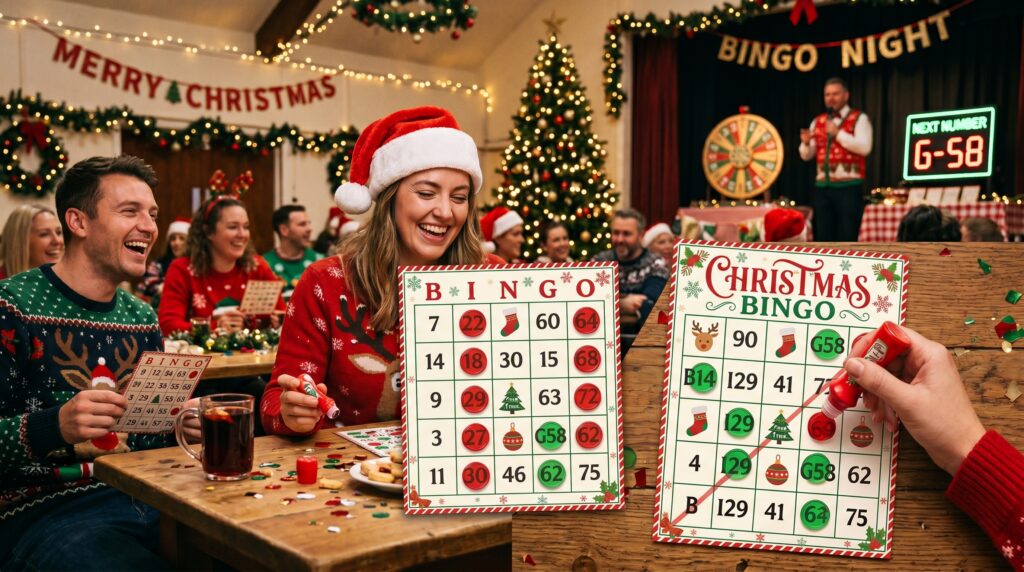
Bingo is one of the most inclusive games because even non-readers and seniors can play successfully with picture cards.
Materials Needed Printed bingo cards (free templates abound online) or DIY grids with 16–25 Christmas images or words (Christmas tree, snowman, candy cane, elf, star, bell, stocking, etc.). Small tokens for marking (buttons, dried beans, or holiday erasers) and a caller who reads descriptions or shows pictures.
How to Play Each player receives a unique card. The caller randomly selects items and describes them (“Something that jingles when you shake it”). Players mark matches. First to complete a row, column, or full card wins a small prize.
In My Experience We once played picture bingo with my niece who was just learning to read. She beamed every time she recognized “Rudolph” before the adults. The game gave her equal footing and created a sweet memory of inclusion.
Why It Works Bingo combines anticipation, pattern recognition, and gentle competition. It is calm enough for after-dinner play yet exciting enough to hold attention.
Pro Tips & Variations
- Create different difficulty levels: pictures for little ones, words for older kids and adults.
- “Blackout” bingo (fill the entire card) works well for longer sessions.
- Use small, thoughtful prizes: handwritten notes (“Good for one extra bedtime story”), holiday stickers, or dollar-store ornaments.
Pros: Easy to scale for any group size, low energy, highly adaptable. Cons: Requires some printing or preparation; mitigate by preparing cards the night before.
3. Pin the Nose on Rudolph: Classic Silly Fun
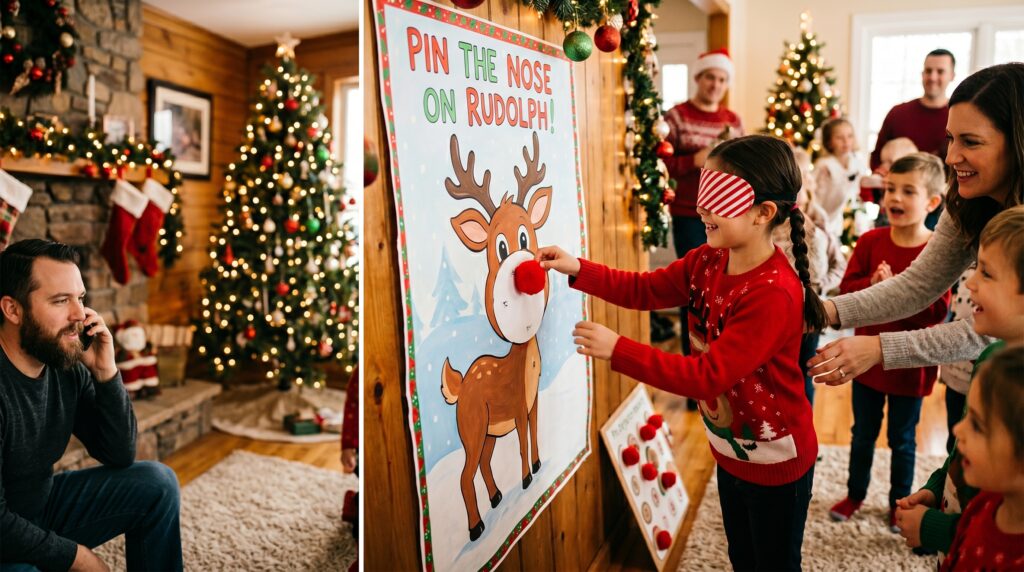
This blindfolded game never fails to produce contagious laughter and adorable photos.
Materials Needed A large poster or drawn Rudolph face on poster board, red paper “noses” with tape on the back, and a blindfold (or scarf).
How to Play Tape the Rudolph poster to a wall at child and adult height. Blindfold players one at a time, spin them gently (or skip spinning for safety), and let them try to place the nose. Closest to the correct spot wins.
In My Experience During one particularly competitive year, my brother-in-law spun himself a little too enthusiastically and ended up pinning the nose on Rudolph’s antler. The photo still lives in our family group chat and gets shared every December.
Why It Works The game equalizes skill levels—everyone looks equally funny blindfolded—and creates shared humor that bonds people quickly.
Pro Tips & Variations
- Use painter’s tape so the poster comes off walls cleanly.
- For very young children, use a large foam board and let them feel their way.
- Add a “Rudolph’s Red Nose” prize for the closest or most creative placement.
Pros: Minimal cost, works in any size space, instant photo opportunities. Cons: Some people dislike blindfolds; offer the option to keep eyes closed or use a very light scarf.
4. Indoor Christmas Scavenger Hunt: Active Exploration Without Leaving Home

A scavenger hunt turns your house into an adventure zone and gets everyone moving.
Materials Needed A printed list of 10–15 items or clues (examples: “something red and shiny,” “a bell that jingles,” “a photo of someone smiling,” “something that smells like cinnamon,” “a Christmas storybook”).
How to Play Players or teams search the house within a time limit (15–25 minutes). First to complete the list or the team with the most creative finds wins. For a photo version, teams must take pictures recreating holiday movie scenes using household props.
In My Experience One year we added a photo challenge: “Recreate the ‘Home Alone’ scream using only items in the living room.” The resulting pictures were so funny we printed them as holiday cards the next year.
Why It Works Scavenger hunts encourage observation, teamwork, and creative problem-solving while giving kids (and adults) a healthy burst of movement indoors.
Pro Tips & Variations
- Make clues age-appropriate: simple descriptions for little ones, riddles for older kids and adults.
- Include “teamwork” items that require two people (e.g., “a photo of two people wearing the same color”).
- End with a small group prize everyone shares, like hot cocoa.
Pros: Uses your existing home, promotes physical activity, highly customizable. Cons: Can get noisy or messy; set clear boundaries about which rooms are off-limits.
5. Oven Mitt Gift Wrapping Race: Hilarious Frustration in the Best Way

This game turns ordinary gift wrapping into a comedy show.
Materials Needed Small boxes or gifts, wrapping paper, tape, scissors, and oven mitts (one pair per player or team).
How to Play Players must wrap (or unwrap) a gift while wearing oven mitts. Set a timer or race head-to-head. Judge on speed, neatness, or creativity—or just enjoy the chaos.
In My Experience The year we tried this, one family member’s “wrapped” gift looked like it had been attacked by a very enthusiastic toddler. We laughed so hard we had to pause the game. The photos remain legendary in our family.
Why It Works The mitts create instant physical comedy while still requiring focus and dexterity. It is surprisingly challenging and therefore deeply satisfying when someone succeeds.
Pro Tips & Variations
- Use dollar-store gifts or empty boxes so no one feels pressure about real presents.
- Add a “best creative wrapping” category judged by the whole family.
- For younger players, use larger mitts or allow one hand free.
Pros: Uses items most kitchens already have, works for small or large groups. Cons: Can be messy with paper scraps; play on a table with a tablecloth underneath.
6. Christmas Trivia Challenge: Test Your Holiday Knowledge
Trivia bridges generations beautifully because everyone brings different strengths.
Materials Needed 20–30 questions about Christmas movies, songs, traditions, and fun facts. You can create your own or use free online lists. Multiple-choice format works well for mixed ages.
How to Play Read questions aloud. Individuals or teams answer. Award points or simply enjoy the discussion. Include categories such as “Classic Movies,” “Christmas Songs,” “Holiday Traditions,” and “Fun Facts.”
In My Experience During one game, the kids dominated the modern animated movie questions while the grandparents knew every lyric to Bing Crosby songs. It became a beautiful exchange of knowledge across generations.
Why It Works Trivia sparks storytelling (“Remember when we watched that movie together?”) and friendly competition without requiring physical skill.
Pro Tips & Variations
- Offer “lifelines” like “ask a family member” to encourage interaction.
- Use a buzzer app on a phone for added excitement.
- Keep a mix of easy and challenging questions so everyone feels successful.
Pros: No physical setup, great conversation starter, educational in a fun way. Cons: Can feel like a test if not kept light; emphasize that guessing is part of the fun.
7. Jingle Bell Toss: Active Skill Game for All Ages

This tossing game provides satisfying feedback with every successful throw.
Materials Needed Small jingle bells (or wrapped coins/candy for a softer option), 6–10 plastic or paper cups arranged in a triangle or straight line on a table or floor, and a throwing line marked with tape.
How to Play Players take turns tossing bells underhand from a set distance (adjust for age). Count how many land in cups. Play to a target score or for a set number of rounds.
In My Experience My competitive uncle, who usually skips “kid games,” got completely absorbed in perfecting his toss. By the end he was high-fiving the youngest players. The game leveled the playing field in the best way.
Why It Works It combines hand-eye coordination with friendly competition and immediate auditory reward (the jingle when a bell lands).
Pro Tips & Variations
- Use different distances or cup sizes for different skill levels.
- Play in teams for doubles tossing.
- For very young children, use a larger target or let them drop bells from above.
Pros: Simple to set up, scalable difficulty, uses inexpensive supplies. Cons: Bells can roll; play on a contained surface or have a “ball boy” retrieve them.
8. Christmas Pictionary: Visual Creativity and Laughter
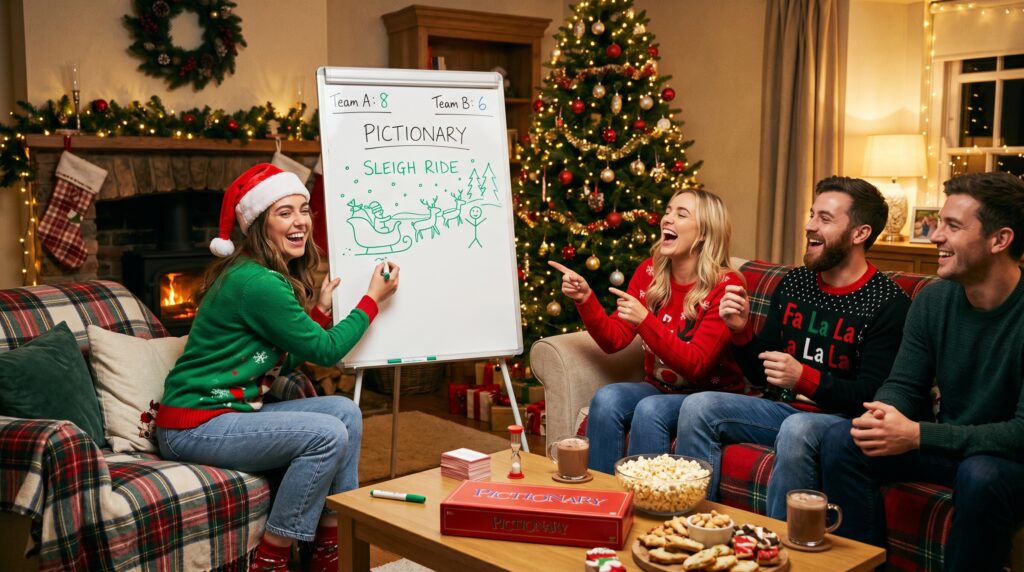
Drawing games reveal hidden talents and produce some of the funniest moments of the night.
Materials Needed Whiteboard, large paper, or individual sketch pads and markers. A list of Christmas words and phrases.
How to Play Similar to charades but visual. One player draws while teammates guess. Time limit of 60–90 seconds per turn.
In My Experience One memorable round involved someone trying to draw “stocking stuffer.” The resulting abstract shape had everyone guessing everything from “sock puppet” to “Christmas pickle.” The laughter was worth more than any prize.
Why It Works Pictionary celebrates different learning styles and gives artistic (and non-artistic) family members equal chances to shine through creativity and quick thinking.
Pro Tips & Variations
- Allow stick figures and symbols—no artistic skill required.
- Categories: Movies, Songs, Foods, Traditions, Characters.
- For little ones: Use simpler words or let them describe their drawing.
Pros: Minimal supplies, works seated or standing, highly replayable. Cons: Some people feel self-conscious drawing; emphasize that bad drawings often lead to the best laughs.
9. Toilet Paper Snowman Challenge: The Ultimate Photo-Op Game
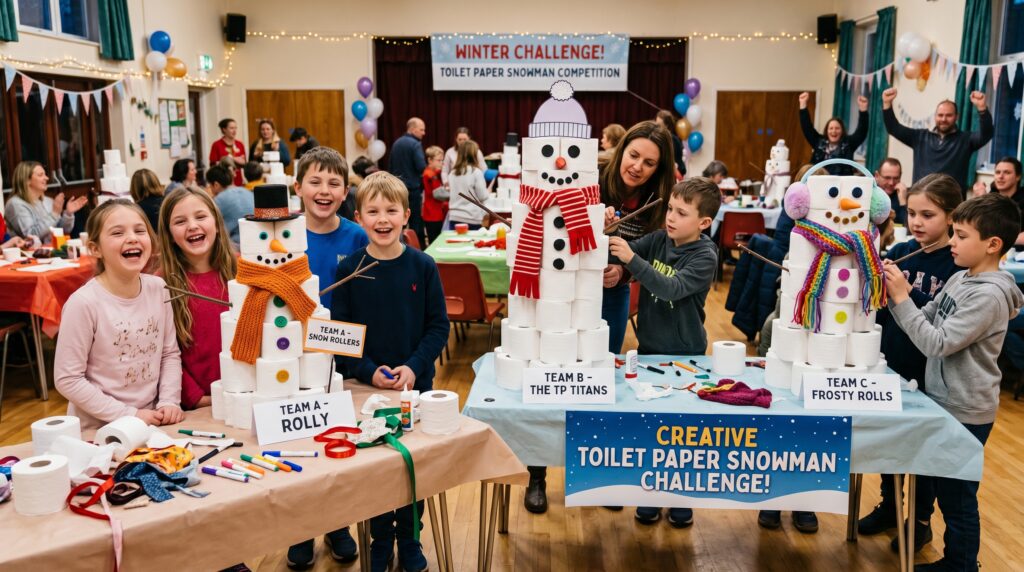
This game turns ordinary bathroom supplies into comedy gold and unforgettable memories.
Materials Needed Several rolls of toilet paper per team, tape, scissors, construction paper or markers, and optional accessories (scarf, hat, carrot or paper nose).
How to Play Divide into teams. Choose one person to be the “snowman.” Teams have 5–8 minutes to wrap their snowman and add a face and decorations. Judge on creativity, speed, or overall appearance.
In My Experience The resulting snow people looked like modern art installations. One team added a paper carrot nose that kept falling off, leading to improvised solutions and more laughter. We still have the group photo framed.
Why It Works It combines creativity, gentle physical contact (wrapping), and teamwork in a completely absurd and joyful way.
Pro Tips & Variations
- Leave the face area clear for comfort and safety.
- Award categories: “Most Creative,” “Fastest,” “Best Use of Household Items.”
- Use the finished snowmen as photo props for the rest of the evening.
Pros: Extremely cheap, uses common household items, produces amazing photos. Cons: Can be messy with paper scraps; play on a hard floor and have a vacuum ready.
10. Christmas Would You Rather: Conversation Without Competition
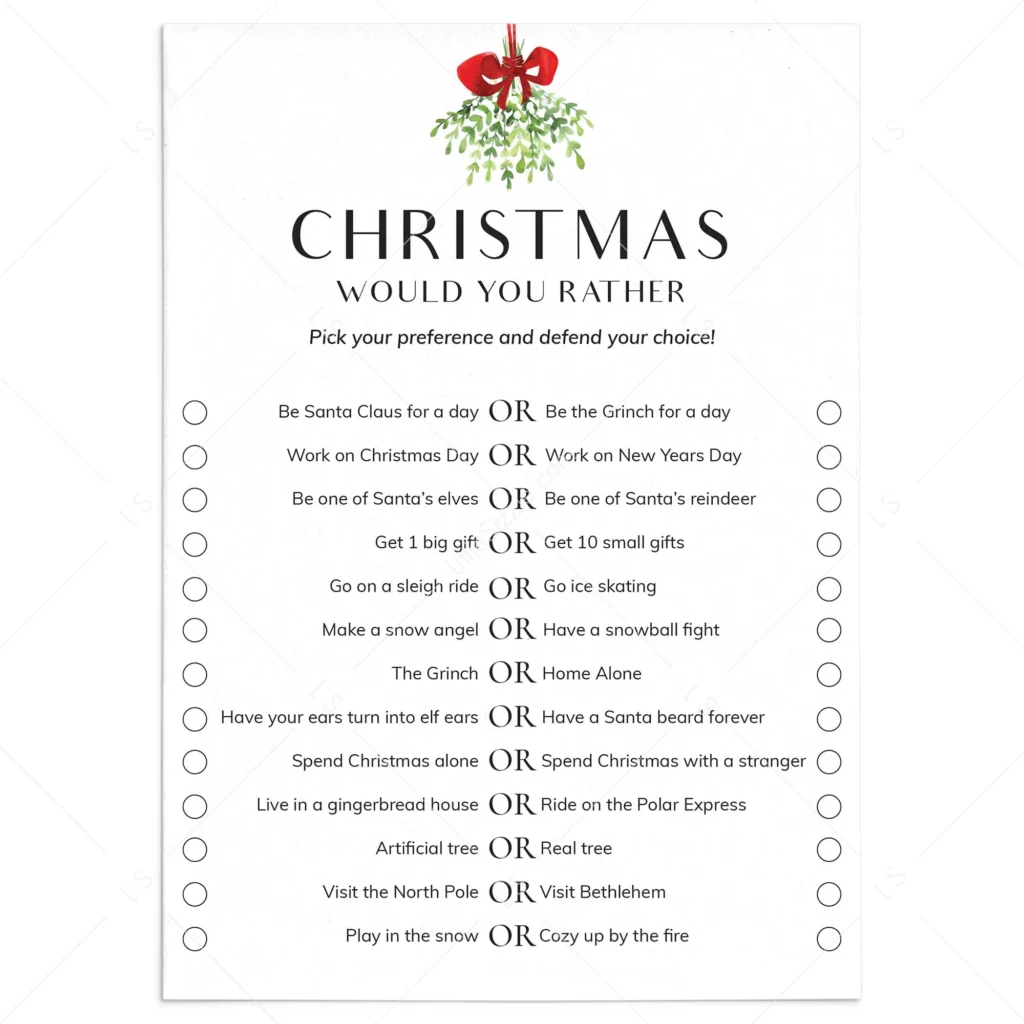
When energy is low or you want something seated and reflective, this game shines.
Materials Needed A list of 15–25 “Would you rather” questions (no supplies needed beyond imagination).
How to Play Read a question aloud. Everyone chooses an option and explains why. No winners or losers—just discussion and laughter.
Sample Questions
- Would you rather have Christmas every day or only once a year?
- Would you rather eat only fruitcake for a week or only candy canes?
- Would you rather be Santa’s helper for a day or the Grinch for a day?
- Would you rather open all your presents on Christmas Eve or Christmas morning?
In My Experience This game often leads to the most meaningful conversations. One year a simple question about traditions sparked my mother sharing stories from her childhood Christmases that none of us had heard before.
Why It Works It requires zero preparation, works for any group size or energy level, and reveals personalities and values in a safe, fun format.
Pro Tips & Variations
- Let family members create their own questions.
- For younger kids, keep questions silly and concrete.
- Use it as a wind-down game before bed or while waiting for dinner.
Pros: No cost, no setup, deepens relationships through conversation. Cons: Can run long if everyone shares long stories; set a gentle time limit per question if needed.
Conclusion
The most meaningful Christmas traditions are rarely the most expensive or elaborate. They are the ones that bring people together in genuine, joyful interaction the kind that happens naturally when you clear a little space in the living room and say, “Who wants to play a game?”
These 10 easy Christmas games have been tested in real homes with real families of every size and configuration. They require almost nothing beyond a willingness to laugh at yourselves and celebrate each other. Start with one or two that appeal to your crew this year. You may discover a new annual tradition that everyone looks forward to.
In the end, the greatest gift you can give your family is not another toy or gadget—it is your presence, your laughter, and the memories you create together. May your holiday season be filled with connection, kindness, and plenty of joyful chaos.
Happy holidays, and may your games be merry and bright.
FAQs
What if our family has a very wide age range?
Mix teams so every group has a mix of ages. Choose games with both active and seated options, and always have a “helper” role for younger or older players. The goal is inclusion, not perfect competition.
Do these games work in small apartments or limited space?
Absolutely. Charades, Pictionary, Would You Rather, Trivia, and Bingo require almost no movement. Scavenger hunts and toss games can be adapted to one or two rooms.
How do I keep games from becoming too competitive?
Focus on participation and laughter. Use team scoring instead of individual winners, offer “most creative” or “best sport” awards, and model graciousness when you lose. Remind everyone the real prize is time together.
What are good low-cost or no-cost prizes?
Handwritten coupons (“Good for choosing the next movie”), small ornaments, holiday stickers, extra dessert, or the honor of picking the next game. Experiences often mean more than objects.
Are these games suitable for people with mobility challenges or sensory sensitivities?
Yes. Offer seated versions of active games, allow breaks, use softer lighting or noise levels, and let players opt out of any element that feels uncomfortable. Flexibility is key to true inclusion.
How long should we plan for each game?
Most of these games take 10–25 minutes. You can easily play three or four in an evening without anyone getting bored.
Can we play any of these virtually if family members are apart?
Charades, Pictionary, Trivia, and Would You Rather work wonderfully over video calls. Use screen sharing for drawing or shared lists.
What if someone doesn’t want to play?
Never force participation. Offer observer roles, score-keeping, or simply enjoying the snacks and conversation. Some people warm up after watching one round.