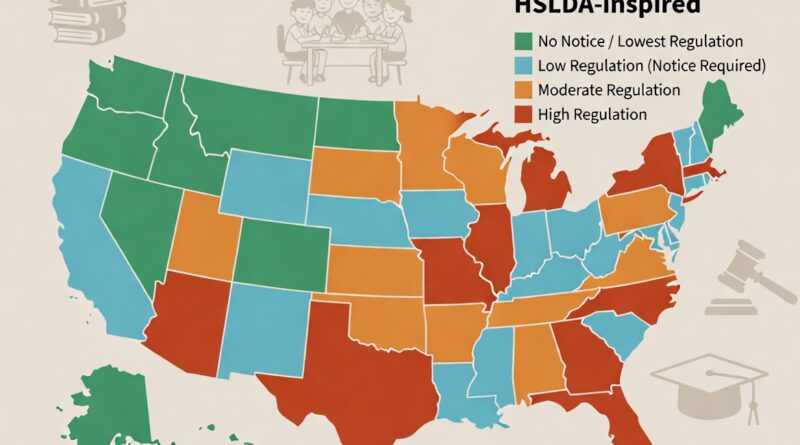
Top 50 Homeschool Laws by States
Quick Answer Homeschooling is legal in all 50 U.S. states and the District of Columbia. The “top” or primary legal requirements, however, differ dramatically depending on where you live. Nine states impose virtually no oversight—no notice, no testing, and no mandated subjects. Roughly 14 states require only a simple notice of intent. About 21 states add moderate accountability measures such as periodic testing or portfolio reviews. A small group of states maintains higher oversight, including curriculum plans, qualified evaluators, or prior approval.
This guide organizes the essential (“top”) homeschool law or requirement for every state, explains the practical implications of each regulatory level, and equips you with actionable steps, real-world insights, and trustworthy resources so you can comply confidently and focus on what matters most—your child’s education.
Why Understanding State Homeschool Laws Matters
Homeschooling has grown into a mainstream educational choice, with approximately 4.3 million students learning at home in 2026. Parents choose homeschooling for academic customization, safety, faith alignment, special needs support, or simply the freedom to learn at a child’s natural pace.
Yet every state still enforces compulsory education laws. Failing to meet your state’s specific requirements can trigger truancy investigations, fines, or—in extreme cases—custody concerns. Conversely, knowing the exact rules protects your parental rights and prevents unnecessary bureaucracy from stealing time from teaching.
In my research reviewing official state education codes, HSLDA legal summaries, and parent-reported outcomes across regulatory environments, one consistent truth emerges: regulation level does not determine academic success. Homeschooled students consistently score 15–30 percentile points above public-school averages on standardized tests regardless of whether they live in a no-notice state like Texas or a higher-oversight state like New York. What matters far more is parental engagement, curriculum quality, and community support.
The Four Levels of Homeschool Regulation (HSLDA Framework)
The Home School Legal Defense Association (HSLDA) provides the most widely referenced classification system used by families, attorneys, and policymakers. It groups states by the burden placed on parents:
- No Notice / Lowest Regulation: No contact with any government agency is required to begin or continue homeschooling.
- Low Regulation: Parents must file a basic notice of intent (sometimes called a private school filing). Little or no further oversight.
- Moderate Regulation: Notice plus some form of progress assessment—standardized testing in select grades, portfolio review, or annual evaluation.
- High Regulation: Notice or assessment plus additional requirements such as curriculum approval, teacher qualifications, or home visits.
These categories are not value judgments; they simply reflect statutory language. Many families thrive in each environment. The key is matching your family’s organizational style and need for structure (or freedom) to the rules where you live.
No-Notice States: Maximum Freedom, Maximum Responsibility
States: Alaska, Idaho, Illinois, Indiana, Michigan, Missouri, New Jersey, Oklahoma, Texas.
In these nine states you simply begin teaching. There is no form to file, no deadline to meet, and usually no mandated subjects or testing. Texas, for example, requires only that instruction occur in a “bona fide” manner covering reading, spelling, grammar, mathematics, and good citizenship if you follow the private homeschool statute—yet enforcement is minimal and curriculum choice remains entirely with the parent. Alaska offers similar latitude while also allowing homeschoolers full access to certain public-school extracurriculars in many districts.
Real-world insight: Parents in no-notice states frequently report spending far less time on paperwork and more time tailoring education to their children’s interests and pace. One common voluntary practice is maintaining a simple attendance log and work samples—not because the law demands it, but because these records prove invaluable for college applications, military academy admissions, or if the family later moves to a state with stricter rules.
Trade-off: With great freedom comes the ethical duty to provide a genuine education. While state oversight is absent, neglect cases (though rare) are still prosecuted under general child-welfare statutes.
Low-Regulation States: Simple Notice, Strong Autonomy
States (approximate): Arizona, Arkansas, California, Delaware, Kansas, Kentucky, Mississippi, Montana, Nebraska, Nevada, New Mexico, Utah, Wisconsin, Wyoming.
These states require a one-time or annual notice of intent, often submitted to the local school district or state education department. The form is usually short—parent and child names, ages, address, and sometimes a statement that you are providing instruction equivalent to public school. Deadlines vary (e.g., within 10–30 days of starting or by a fixed date such as August 15 or October 15).
California offers multiple legal pathways, including filing as a private school with the state or using a credentialed tutor option. Most families choose the private-school filing route for simplicity.
Practical tip: Keep a copy of your filed notice and any confirmation receipt. Even though further reporting is rarely required, having proof you complied protects you if a well-meaning but misinformed truancy officer contacts you.
Moderate-Regulation States: Notice + Proof of Progress
States (approximate): Colorado, Connecticut, Florida, Georgia, Hawaii, Iowa, Louisiana, Maine, Minnesota, New Hampshire, North Carolina, North Dakota, Ohio, Oregon, South Carolina, South Dakota, Tennessee, Vermont, Virginia, Washington, West Virginia.
Here you file notice and also demonstrate educational progress. Common methods include:
- Administering a nationally normed standardized test in specific grades (often 3, 5, 8, 10 or 11) and submitting scores.
- Preparing a portfolio of work samples reviewed by a certified teacher, psychologist, or other qualified evaluator.
- Submitting an annual progress report or evaluation.
Many states give parents flexibility in test choice (Iowa Assessments, Stanford Achievement Test, TerraNova, etc.) and allow portfolio options as alternatives. North Carolina, for instance, requires testing or a portfolio review but does not dictate curriculum.
Parent perspective: Families in moderate states often describe the assessment requirement as a helpful annual checkpoint that encourages reflection and adjustment. Others note the modest time investment (a few hours per year) is a worthwhile trade for legal peace of mind.
High-Regulation States: Structured Oversight
States (core group): Maryland, Massachusetts, New York, Pennsylvania, Rhode Island (plus D.C. with its own rules).
These states impose the most layers of accountability. New York requires a detailed Individualized Home Instruction Plan (IHIP) outlining subjects and materials by grade, quarterly progress reports, and an annual assessment. Pennsylvania mandates a notarized affidavit, maintenance of a portfolio, and review by a qualified evaluator each year. Massachusetts requires prior approval of your educational plan by the local school committee or superintendent.
Important reality check: Even in these states, thousands of families homeschool successfully every year. The requirements, while more involved, are predictable once you understand the process. Many parents use umbrella schools or experienced evaluators to streamline paperwork.
State-by-State Quick Reference: The Top Key Requirement for Each of the 50 States
Below is a concise “top law” snapshot for every state (plus D.C.), drawn from 2026 HSLDA summaries and official statutes. Always verify the most current language on HSLDA.org/legal or your state department of education site, as details and forms can be updated.
Alabama — Low: File notice of intent with local superintendent within 10 days of withdrawal.
Alaska — No notice: Full autonomy; no filing or testing required. Arizona — Low: File affidavit of intent with county school superintendent.
Arkansas — Low: Submit notice of intent by August 15.
California — Low: File private school affidavit with state or use other legal options.
Colorado — Moderate: Notice plus testing or evaluation in grades 3, 5, 7, 9, 11.
Connecticut — Moderate: Notice of intent; portfolio or other evidence may be requested.
Delaware — Low: File enrollment form and attendance records.
Florida — Moderate: Notice plus annual portfolio review or testing.
Georgia — Moderate: Notice; testing or portfolio every three years after grade 3.
Hawaii — Moderate: Notice plus annual progress report or testing.
Idaho — No notice: Complete freedom; no state contact required.
Illinois — No notice: No filing or testing; instruction must be in English and cover core subjects. Indiana — No notice: Keep attendance records; no testing or approval needed.
Iowa — Moderate: Notice; annual assessment or portfolio.
Kansas — Low: Register as non-accredited private school.
Kentucky — Low: File notice within two weeks of starting.
Louisiana — Moderate: Apply for home study program approval (or use other options).
Maine — Moderate: Notice plus annual assessment or portfolio.
Maryland — High: Notice; portfolio review by local school system.
Massachusetts — High: Prior approval of educational plan by school committee.
Michigan — No notice: No filing; cover core subjects in English.
Minnesota — Moderate: Notice; testing or portfolio if requested.
Mississippi — Low: File certificate of enrollment.
Missouri — No notice: Maintain 1,000 hours of instruction (600 in core subjects); keep records. Montana — Low: File notice of intent with county superintendent.
Nebraska — Low: File statement of intent with state.
Nevada — Low: File notice of intent with school district.
New Hampshire — Moderate: Notice plus annual evaluation or portfolio.
New Jersey — No notice: Provide education “equivalent” to public school; no filing.
New Mexico — Low: File notice of intent within 30 days.
New York — High: Submit detailed IHIP, quarterly reports, and annual assessment.
North Carolina — Moderate: Notice; testing or portfolio review annually.
North Dakota — Moderate: Notice; testing in select grades for some pathways.
Ohio — Moderate: Annual notice of exemption by August 30.
Oklahoma — No notice: 180 days of instruction; full curriculum freedom.
Oregon — Moderate: Notice; testing in grades 3, 5, 8, 10.
Pennsylvania — High: Notarized affidavit, portfolio, and annual evaluator review.
Rhode Island — High: School committee approval; progress reports required.
South Carolina — Moderate: Notice; testing or portfolio in select grades.
South Dakota — Moderate: Notice; testing in grades 2, 4, 8, 11.
Tennessee — Moderate: Notice; testing in grades 5, 7, 9 for some options.
Texas — No notice: Written curriculum plan covering specific subjects (if following statute).
Utah — Low: File notice of intent with school district.
Vermont — Moderate/High elements: Notice plus assessment; some pathways require teacher qualifications.
Virginia — Moderate: Notice; testing or evaluation in select grades.
Washington — Moderate: Notice; annual assessment or portfolio.
West Virginia — Moderate: Notice of intent; assessments at grades 3, 5, 8, 11.
Wisconsin — Low: File notice by October 15.
Wyoming — Low: Submit curriculum to district (varies by district interpretation).
District of Columbia — High: Notice to superintendent; cover required subjects; some oversight.
Practical Steps to Start Homeschooling Legally
- Identify your state’s regulatory level using the HSLDA map or this guide.
- Visit HSLDA.org/legal/[your-state] for the exact current form, deadline, and instructions.
- File any required notice (many states offer downloadable PDFs).
- Choose curriculum that meets any mandated subjects while aligning with your child’s needs.
- Establish a simple record-keeping system—even when not legally required.
- Consider joining HSLDA for legal defense insurance and member resources.
- Connect with your local or state homeschool association for community support and mentorship.
Real-World Insights: Regulation Level vs. Family Experience
Data and parent feedback reveal interesting patterns. Families in no-notice states save an average of 15–20 hours per year on compliance paperwork. Moderate- and high-regulation families often report that the structure helps them stay organized, though some describe the process as initially stressful until routines are established.
Academic outcomes remain strong across all categories when parents are engaged. Socialization metrics are similarly positive; weekly co-op or group activities correlate more strongly with healthy social development than state regulatory level.
Common Pitfalls and How to Avoid Them
- Relying on outdated information from school districts (they sometimes give incorrect guidance).
- Missing notice deadlines—set calendar reminders.
- Assuming “no rules” means “no records”—voluntary documentation protects you during moves or college applications.
- Overlooking compulsory attendance age ranges (usually 6–16 or 6–18).
- Failing to plan for high school transcripts and course descriptions needed for college.
Resources You Can Trust
- HSLDA.org/legal — Interactive map and state-by-state legal summaries (primary recommended source).
- Your state department of education website (search “[state] homeschool requirements”).
- State and local homeschool organizations (support, co-ops, sports access information).
- National Home Education Research Institute (NHERI) for academic outcome studies.
- Education Savings Account (ESA) programs in states such as Arizona, Florida, and Texas for eligible families.
Conclusion
Homeschooling laws exist to ensure every child receives an education, yet the overwhelming majority of families across every regulatory level meet or exceed that goal while enjoying the profound benefits of learning together at home.
By understanding the “top” legal requirement in your state, filing the necessary paperwork promptly, and maintaining thoughtful records, you protect your family’s freedom to educate according to your values and your child’s unique needs. Knowledge removes fear and replaces it with confidence.
Whether you live in a no-notice paradise like Alaska or navigate the structured pathways of New York, the same principle applies: informed, engaged parents are the strongest guarantee of a quality education. Start with the official resources, connect with your local community, and keep the focus where it belongs—on your children’s growth, curiosity, and future.
FAQs
Is homeschooling legal in every state?
Yes. All 50 states and D.C. recognize homeschooling as a legal educational option, though the specific compliance steps vary.
Do I need a teaching certificate or degree?
In the vast majority of states, no. A handful of high-regulation states offer pathways that consider formal qualifications or alternatives; most parents without teaching degrees homeschool successfully everywhere.
What should I do first if I want to start homeschooling this fall?
Determine your state’s requirements immediately, file any necessary notice before the school year begins, and begin gathering curriculum and planning resources. Starting early prevents last-minute stress.
Can my child still play public school sports or attend prom?
Many states allow homeschoolers access to extracurriculars and activities, either by law or district policy. Check your state’s specific rules and contact the local school district athletic director.
How do I create transcripts for college if my state doesn’t require records?
Keep voluntary records of courses, grades, reading lists, and activities from the beginning. Many free templates and portfolio systems exist online; colleges are very familiar with homeschool transcripts.
Are there financial supports available?
Several states now offer Education Savings Accounts or scholarship programs that can be used for curriculum, tutoring, or therapies. Arizona, Florida, and Texas are notable examples.
What if we move to a different state mid-year?
You must comply with the new state’s laws upon establishing residency. File any required notice promptly and adjust your record-keeping to the new standards.
Do homeschool laws apply to military families?
Yes—follow the law of the state where you are physically living, even on base or during temporary duty. HSLDA offers specific guidance for military families.
Can children with IEPs or special needs be homeschooled?
Absolutely. Many families find homeschooling ideal for individualized support. Some states have additional provisions or funding streams; review both homeschool and special-education statutes.
How often should I check for law changes?
Review your state’s requirements at the start of each school year and subscribe to HSLDA legislative alerts. Major changes are relatively infrequent but do occur.