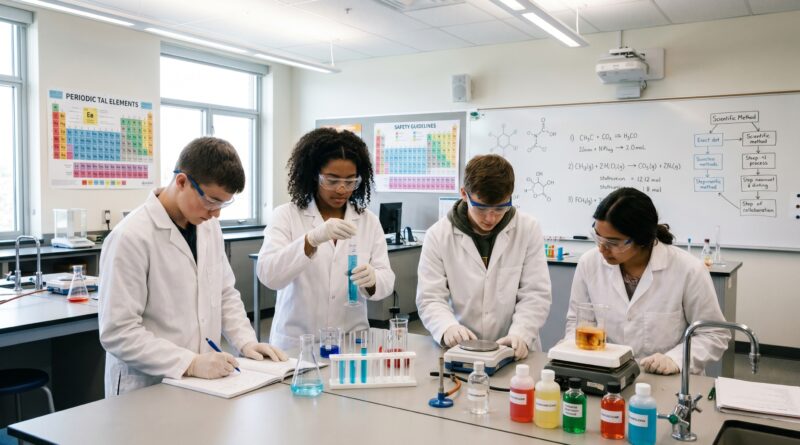
Secular High School Chemistry Curriculum
Quick Answer
A secular high school chemistry curriculum delivers a rigorous, evidence-based education in the fundamental principles of matter, energy, and chemical change. It aligns with the Next Generation Science Standards (NGSS) or equivalent state frameworks, emphasizing scientific practices such as modeling, investigation, data analysis, and argumentation. Core topics include atomic structure, the periodic table, chemical bonding and reactions, stoichiometry, states of matter, thermochemistry, kinetics, equilibrium, acids and bases, redox processes, and introductory organic and nuclear chemistry.
Unlike faith-based programs that may integrate religious interpretations of origins or design, secular curricula focus exclusively on empirical evidence, peer-reviewed science, and the scientific method. Top accessible options for U.S. families include the free CK-12 Chemistry FlexBook, OpenStax Chemistry 2e, Conceptual Chemistry by John Suchocki (via Conceptual Academy), Focus On High School Chemistry, and literature-rich programs like Guest Hollow’s Chemistry in the Kitchen. These support both classroom and homeschool settings while preparing students for college-level science, standardized testing, and STEM careers. Hands-on or virtual labs are essential for developing practical skills and meeting lab science credit requirements in most states.
Introduction
Chemistry is the central science. It explains everything from the air we breathe and the medicines that heal us to the materials in our phones and the processes driving climate systems. For high school students in the United States, a strong chemistry foundation is often a graduation requirement and a gateway to college majors in biology, engineering, medicine, environmental science, and more.
In 2026, parents and educators seeking a secular high school chemistry curriculum typically want one thing above all: science instruction grounded purely in evidence, testable hypotheses, and the evolving body of scientific knowledge—without religious doctrine or worldview overlays. This approach mirrors what students encounter in public schools and most colleges, promoting critical thinking and inclusivity.
Whether you are homeschooling, supplementing a public or charter school program, or designing a hybrid course, choosing the right secular curriculum matters. The best programs do more than deliver facts; they cultivate scientific habits of mind. They help students ask better questions, design investigations, interpret data, and connect abstract concepts to real-world phenomena like sustainable energy, water quality, or pharmaceutical development.
This comprehensive guide draws on my 15+ years as a high school chemistry teacher, curriculum consultant, and NGSS implementation coach. I have seen curricula succeed and struggle in diverse settings—from large public classrooms to small homeschool co-ops. You will find clear explanations of what makes a curriculum secular, detailed reviews of top options, practical advice on labs and assessment, and honest discussions of trade-offs. The goal is to help you make an informed choice that fits your student’s needs, your resources, and your educational philosophy.

What Defines a Secular High School Chemistry Curriculum?
A secular chemistry curriculum teaches science as a human endeavor built on observation, experimentation, and revision of ideas based on evidence. It presents atomic theory as a model refined over centuries—from Dalton’s indivisible atoms to the quantum mechanical model—without attributing natural phenomena to supernatural causes or “intelligent design” within the scientific explanation itself.
Key characteristics include:
- Alignment with NGSS or state standards: Emphasis on three dimensions—disciplinary core ideas (especially HS-PS1: Matter and Its Interactions), science and engineering practices, and crosscutting concepts (patterns, systems, energy and matter).
- Focus on the scientific method and nature of science: Students learn how models are developed, tested, and revised. They evaluate evidence and distinguish science from pseudoscience.
- No religious integration: Explanations of the origin of elements (Big Bang nucleosynthesis), the age of Earth, or biochemical evolution remain within the bounds of scientific consensus.
- Inclusivity and evidence-based ethics: Discussions of chemistry’s societal impacts (pollution, green chemistry, medicine access) remain factual and solutions-oriented.
Secular does not mean anti-religion. Many families of faith choose secular science curricula for school hours while integrating their beliefs at home. The separation keeps science class focused on what can be tested and falsified.
In my experience, classrooms and co-ops using purely secular materials report higher comfort levels among students from diverse religious and non-religious backgrounds. Discussions stay centered on data—for example, “What does the periodic trend in ionization energy tell us about atomic structure?” rather than debates over ultimate origins.
Core Topics and NGSS Alignment
A complete high school chemistry course typically spans one academic year (or longer in a block schedule) and covers these major areas, directly tied to NGSS performance expectations:
Atomic Structure and the Periodic Table (HS-PS1-1) Students use the periodic table as a predictive model. They explore electron configurations, trends in atomic radius, ionization energy, and electronegativity. Secular curricula present these patterns as emerging from quantum mechanics and experimental data (spectroscopy, X-ray diffraction).
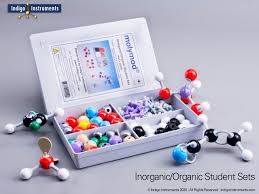
Chemical Bonding and Molecular Geometry Ionic, covalent, and metallic bonding; Lewis structures, VSEPR theory, polarity, and intermolecular forces. Students build and manipulate molecular models to predict properties like boiling point or solubility.
Chemical Reactions, Stoichiometry, and the Mole (HS-PS1-2, HS-PS1-7) Balancing equations, limiting reactants, percent yield, and solution stoichiometry. Real-world connections include pharmaceutical dosing and environmental pollutant tracking.
States of Matter, Gases, and Solutions Kinetic molecular theory, gas laws (including mathematical applications of PV=nRT PV = nRT ), phase changes, and solution chemistry (molarity, colligative properties).
Thermochemistry and Energy Changes (HS-PS1-4) Endothermic and exothermic processes, enthalpy, Hess’s law, and calorimetry. Students often calculate energy changes in hand warmers or combustion reactions.
Kinetics and Chemical Equilibrium (HS-PS1-5, HS-PS1-6) Reaction rates, collision theory, Le Chatelier’s principle, and equilibrium constants. Classic demos include the cobalt chloride equilibrium or iodine clock reaction.
Acids, Bases, pH, and Redox Reactions Brønsted-Lowry and Lewis definitions, titration curves, buffers, and electrochemistry (voltaic and electrolytic cells). Applications range from stomach acid to batteries and corrosion prevention.
Nuclear Chemistry and Organic Chemistry (Introductory) Radioactive decay, half-life, fission/fusion, and basic hydrocarbon nomenclature plus functional groups. These units connect to medicine (PET scans), energy, and materials science.
Most rigorous programs also integrate algebra throughout (solving for unknowns in gas laws or equilibrium expressions) and introduce basic statistical analysis of lab data.
Why Choose a Secular Curriculum?
Advantages:
- Strong alignment with college expectations and most state graduation requirements for lab science.
- Prepares students for AP Chemistry, dual-enrollment courses, or community college chemistry without worldview conflicts.
- Promotes scientific literacy essential for informed citizenship on issues like climate chemistry, plastics recycling, and public health.
- Avoids potential legal or social friction in co-ops or hybrid settings with mixed-belief families.
Considerations:
- Some families prefer curricula that explicitly discuss faith-science compatibility; secular programs leave that conversation to the family.
- Certain faith-based programs offer strong lab components or narrative styles that some students enjoy; secular alternatives can match or exceed them in rigor and engagement when chosen carefully.
When I have helped families transition from faith-based to secular programs (or vice versa), the deciding factor is almost always “fit with long-term goals”—college admissions, major requirements, or simply the student’s learning style and interests.
Top Recommended Secular High School Chemistry Curricula
Here is a comparison of strong, widely used secular options suitable for U.S. homeschoolers, private schools, or supplemental use. All are secular or neutral in presentation.
Detailed Reviews
CK-12 Chemistry FlexBook stands out for accessibility. Chapters can be rearranged or edited. Interactive simulations let students manipulate variables in real time—excellent for exploring gas laws or equilibrium shifts. Many secular homeschool families use it as a spine and add a lab kit or co-op experiments.Opened
OpenStax Chemistry 2e provides college-level clarity and depth at no cost. It excels at linking concepts to sustainability, medicine, and materials. Pair it with PhET simulations and a good lab manual for a powerful, low-cost honors or AP-prep track.
Conceptual Chemistry by John Suchocki receives consistent praise in secular homeschool communities for its visual, story-driven approach. The author’s video lessons on Conceptual Academy help students “see” atoms and molecules. It builds intuition effectively before heavy mathematical formalism.Cathyduffyreviews
Focus On High School Chemistry and similar lab-oriented programs deliver concrete experiments designed for home settings, reinforcing concepts through direct observation.
Guest Hollow’s Chemistry in the Kitchen shines for students who need motivation. By embedding chemistry in cooking, cleaning, and everyday phenomena, it lowers the affective filter while still covering substantial content.
Other solid mentions include video-supported programs designed by veteran public school teachers (such as Chemistry 4 Homeschool) and publisher options like Pearson or McGraw-Hill texts used in many U.S. public schools—these are thoroughly secular and standards-aligned but more expensive for individual purchase.
Implementing Hands-On Labs Safely and Effectively
Labs transform chemistry from abstract symbols into lived experience. NGSS expects students to plan and conduct investigations, analyze data, and use models—activities best supported by laboratory work.
Safety is non-negotiable. Always require safety goggles, closed-toe shoes, and adult supervision. Maintain Safety Data Sheets (SDS) for all chemicals. Use microscale techniques when possible to reduce hazards and waste. Homeschool families should check local regulations and consider liability insurance.
Practical options:
- Virtual labs: PhET Interactive Simulations (University of Colorado) are free, research-based, and outstanding for kinetics, equilibrium, and acid-base titrations.
- Home kits: Home Science Tools, Carolina Biological, or similar vendors offer affordable, safety-focused kits aligned with high school topics.
- Household chemistry: Many excellent investigations use baking soda, vinegar, iodine, cornstarch, and food dyes—perfect for programs like Guest Hollow.
- Hybrid or co-op: Share equipment or rent time in a local school or community college lab.
In my own teaching and consulting, students who regularly engaged in well-designed labs—whether physical or virtual—showed measurably stronger ability to explain particle-level mechanisms and design follow-up experiments.
Assessment, College Preparation, and Transcripts
Effective assessment blends formative checks (exit tickets, concept maps, lab reflections) with summative demonstrations (unit tests, lab reports, capstone projects). Many curricula include quizzes and tests; parents can supplement with free resources from CK-12 or teacher-created rubrics.
For college-bound students:
- Maintain a detailed lab notebook or portfolio documenting experiments, data, and conclusions.
- Consider AP Chemistry (requires significant lab time—roughly 25% of instructional hours) or dual enrollment.
- Strong performance in a rigorous secular chemistry course signals readiness for university STEM pathways.
Document everything clearly for transcripts: course title, hours, materials used, and lab component description.
Common Challenges and Solutions
Challenge: Limited lab access or parent chemistry background. Solution: Start with high-quality virtual simulations + one solid kit. Use teacher editions, answer keys, and online communities (secular homeschool science groups). Many parents successfully teach alongside their students.
Challenge: Math anxiety or weak algebra skills. Solution: Choose a more conceptual entry point (Suchocki or kitchen chemistry) while simultaneously strengthening algebra. Revisit quantitative topics once confidence grows.
Challenge: Student disengagement. Solution: Hook lessons with relevant phenomena—chemistry of skincare, battery technology, ocean acidification, or forensic analysis. Project-based units dramatically increase ownership.
Challenge: Meeting state-specific requirements. Solution: Review your state’s homeschool or private school regulations early. Most accept well-documented lab science courses; some specify minimum lab hours.
Conclusion
Choosing a secular high school chemistry curriculum is an investment in your student’s scientific literacy and future opportunities. The strongest programs combine clear conceptual development, meaningful mathematical application, and authentic laboratory experiences—all grounded in evidence and aligned with modern standards like NGSS.
Whether you begin with the completely free CK-12 FlexBook, invest in Conceptual Chemistry’s engaging video lessons, or build a custom course around OpenStax and quality lab kits, excellent options exist for every budget and learning style. The key is matching the curriculum’s philosophy, depth, and format to your student’s needs while ensuring robust hands-on work and clear documentation.
Chemistry reveals the elegant, understandable rules governing our material world. A well-chosen secular curriculum gives students the tools to explore those rules confidently, ask better questions, and contribute thoughtfully to the scientific and technological challenges of their generation.
Start exploring the free resources today. Review your state requirements, talk with your student about their interests and goals, and don’t hesitate to reach out to experienced homeschool science communities for real-time advice. Your student’s curiosity, guided by solid evidence-based instruction, is the most powerful resource of all.
FAQs
What is the main difference between secular and faith-based high school chemistry curricula?
Secular programs teach chemistry solely through empirical evidence and scientific consensus. Faith-based programs may incorporate religious perspectives on origins, purpose, or ethics alongside scientific content. Both can be academically rigorous; the choice depends on family values and long-term educational goals.
Is a free curriculum like CK-12 rigorous enough for college preparation?
Yes, when used thoughtfully with labs and supplemental practice. Many students using CK-12 or OpenStax successfully transition into university general chemistry. Add depth through projects, AP resources, or tutoring as needed.
How important are labs for high school chemistry credit and college readiness?
Extremely important. Labs develop skills in observation, measurement, data analysis, and safety that lectures alone cannot provide. Most colleges and many states expect documented laboratory experience for science credit.
Can I mix and match resources?
Absolutely. Many successful families use one program as a spine (e.g., CK-12 or Conceptual Chemistry) and supplement labs or specific units from another source. Flexibility is a strength of homeschooling and hybrid models.
What math background is recommended?
Solid Algebra 1 is usually required; Algebra 2 or concurrent enrollment is ideal for stoichiometry, gas laws, equilibrium calculations, and pH. Some conceptual programs reduce the early math load.
How do secular curricula handle topics like the origin of elements or climate chemistry?
They present current scientific understanding: elements formed primarily through Big Bang nucleosynthesis and stellar processes; rising CO₂ levels and ocean acidification are explained through well-established chemical principles and data. Ethical or values discussions remain separate from the scientific content.
Are there good options for students with learning differences?
Yes. Programs with strong visual components (Conceptual Chemistry, CK-12 interactives) and flexible pacing work well. Kitchen chemistry or project-based approaches can reduce text load. Consider audiobooks, graphic organizers, or working with a specialized tutor.
What is a realistic budget for a quality secular chemistry course with labs?
$0–150 for free digital programs plus a $150–400 lab kit or virtual lab subscription. Structured video or textbook programs with labs typically range $200–600 total.