15 Best Charlotte Mason Copywork Ideas for All Ages
Charlotte Mason copywork is one of the simplest yet most transformative practices in a living education. It goes far beyond rote handwriting drills. By carefully transcribing passages of beautiful, well-crafted language, children develop strong penmanship, internalize correct spelling and grammar, absorb rich vocabulary and literary style, and fill their minds with noble ideas—all in short, focused lessons that respect their developing attention.
If you’re looking for fresh, effective Charlotte Mason copywork ideas, this guide delivers 15 of the best, organized for every stage from early learners to high schoolers. Whether you’re new to the Charlotte Mason method or refining your language arts approach, these ideas will help you create meaningful copywork that builds skills and character without worksheets or busywork.
Quick Answer
Charlotte Mason copywork is the practice of carefully copying high-quality passages from literature, poetry, the Bible, proverbs, or living books to develop handwriting, spelling, punctuation, grammar awareness, and an appreciation for beautiful language.
The 15 best ideas include short Bible verses, proverb, poetry from A Child’s Garden of Verses, excerpts from books your children are already reading, nature descriptions, hymns, Aesop’s fables, historical quotes, Shakespeare (for older students), and more. Sessions last just 5–15 minutes. Start with very short passages for young children and gradually increase length as neatness and attention improve.
When implemented consistently with good models, self-correction, and passages tied to your child’s reading, copywork yields noticeable gains in handwriting fluency, spelling accuracy, and expressive writing over time. It also nurtures patience, attention to detail, and a lifelong love of great words.
What Is Charlotte Mason Copywork?
Charlotte Mason emphasized that young children should learn letter formation and handwriting through careful, intentional practice rather than mechanical drills. In her writings on early education, she described beginning with single strokes or letters and progressing only when the child could form them well. Copywork extends this principle: children copy complete passages of excellent writing so they absorb not just mechanics but also style, rhythm, and ideas.
Unlike modern handwriting worksheets that often use repetitive phrases or nonsense sentences, CM copywork uses real literature, Scripture, and poetry. The child studies the model, copies it in their best handwriting, then compares their work to the original and makes corrections. This process builds observation skills and self-editing habits naturally.
Over time, copywork evolves. Early stages focus on manuscript letter formation and neatness. Later, children move into longer passages, cursive, and eventually “transcription”—copying from memory after reading a passage. This naturally leads into dictation and original composition.
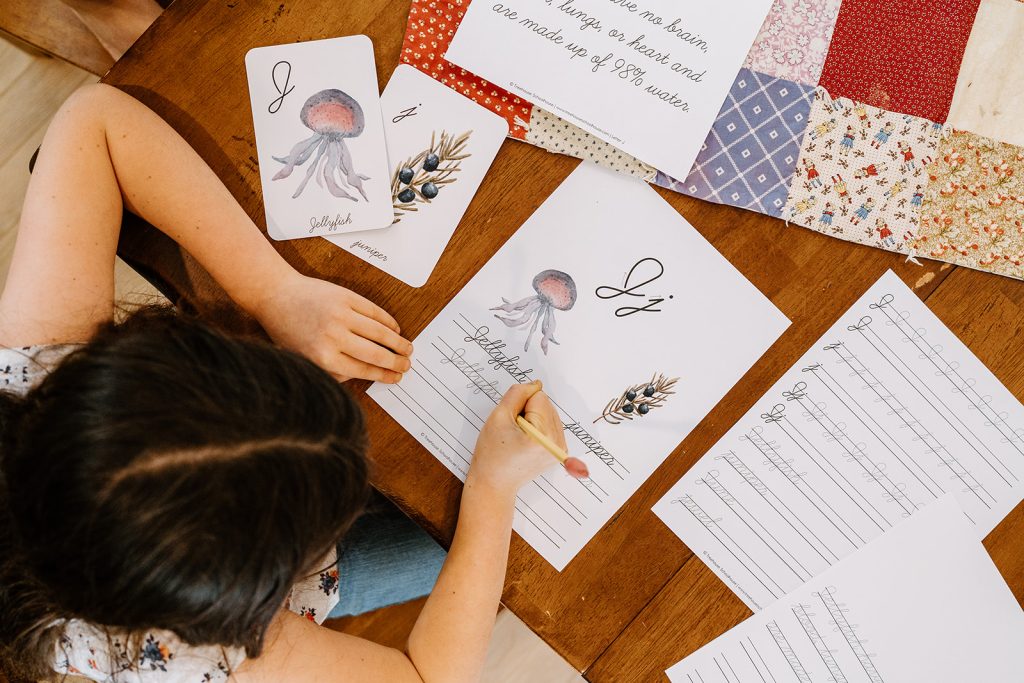
Why Copywork Works So Well: Experience and Results
In my experience working with my own children and mentoring other CM families, copywork has consistently delivered results that worksheets rarely match. When we began using short Bible verses and poetry with my oldest at age 6, his handwriting transformed within months—from hesitant and irregular to confident and legible. More importantly, he started noticing beautiful phrasing in the books we read aloud and began incorporating richer language into his own narrations.
The power lies in the combination of motor skill practice with intellectual and aesthetic nourishment. Children slow down, pay attention to every detail of punctuation and capitalization, and internalize sparkling prose. As Ambleside Online notes, properly done copywork “forces a child to slow down and absorb the punctuation details, notice capitalization, and internalize sparkling prose.”
Parents frequently report improvements in spelling (because children see and write correct forms repeatedly in context), sentence structure awareness, and even reading fluency. Because the passages are meaningful, children are more motivated than with generic drills. Short lessons prevent fatigue and keep the focus on quality over quantity.
That said, copywork is not magic and requires thoughtful implementation. Rushing or using poor models diminishes the benefits. It also works best when paired with the broader CM language arts progression rather than used in isolation.
How to Get Started with Charlotte Mason Copywork
Materials:
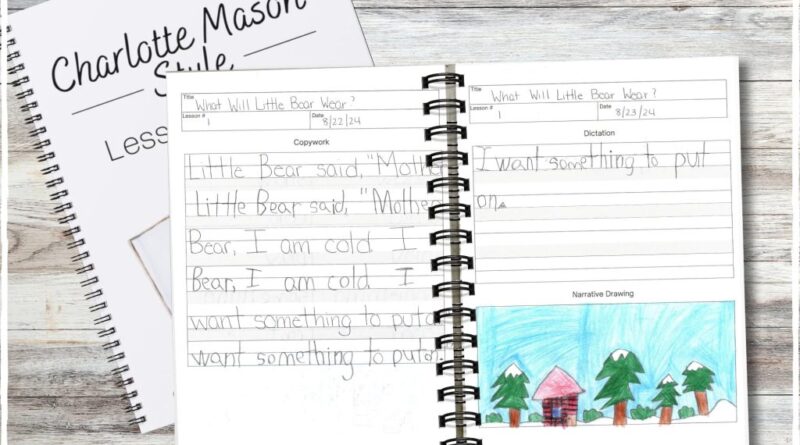
- Good lined paper or a dedicated copywork notebook (some families use spiral notebooks with date and lesson number, as shown in many CM examples).
- A sharp pencil (or fountain pen for older students who enjoy them).
- A clear model of the passage (handwritten by you in your best writing or a clean printed version).
Basic Process:
- Present the model passage.
- Have the child study it briefly.
- Child copies carefully while referring to the model as needed.
- Child compares their work to the model and corrects any differences (with gentle guidance at first).
- Keep sessions short—stop while the child is still succeeding.
Progression Tips:
- Ages 4–7: Start with single letters, strokes, or very short phrases (2–5 words). Focus on proper formation and sitting on the line.
- Ages 8–11: Move to full sentences and short paragraphs. Introduce cursive when manuscript is solid.
- Ages 12+: Longer passages (half to full page), attention to literary style, and transcription from memory.
Choose passages from books your children are already reading or loving—this creates powerful connections. Vary the type of passage throughout the week (Bible one day, poetry another, literature another) to keep interest high.
Pro Tip: Sit with younger children and watch their letter formation. Gently correct strokes that go the wrong direction before bad habits set. This investment pays off enormously.
15 Best Charlotte Mason Copywork Ideas for All Ages
Here are 15 proven, high-impact ideas drawn from Charlotte Mason principles and refined through years of homeschool practice. Each includes age guidance, example passages, implementation tips, and real-world observations.
1. Short Bible Verses Ideal starting point for all ages. Scripture offers beautiful, memorable language with moral weight. Example (early): “Be kind to one another.” (Ephesians 4:32) Example (older): A full verse or two from Psalm 23 or the Beatitudes. Tip: Use the same verse for a week so children can focus on neatness rather than new text. Many families note improved memorization as a bonus. In our home, daily Bible copywork became a calm, centering part of morning time.
2. Proverbs and Wise Sayings Short, pithy statements packed with wisdom and perfect for teaching sentence structure. Example: “A gentle answer turns away wrath, but a harsh word stirs up anger.” (Proverbs 15:1) Tip: Discuss the meaning briefly after copying. Older children enjoy comparing different translations. These build character while practicing writing.
3. Poetry from A Child’s Garden of Verses by Robert Louis Stevenson Charming, rhythmic poems perfect for young children and still delightful for older ones. Example: “At the seaside, or the mountains, or the zoo…” (short stanza). Tip: Copy one stanza at a time. The rhyme and rhythm help with phrasing and enjoyment. Many parents report children spontaneously reciting these later.
4. Excerpts from Living Books They’re Currently Reading Tie copywork directly to your literature or history studies for maximum relevance. Example: A descriptive paragraph from Little House on the Prairie or a scene from The Chronicles of Narnia. Tip: Let children help choose the passage. This increases buy-in and reinforces the story. One of the most powerful connections I’ve seen.
5. Nature Poetry or Descriptions Connects beautifully with CM nature study. Example: “I think that I shall never see / A poem lovely as a tree…” (Joyce Kilmer, “Trees”). Tip: Pair with a nature walk and journal entry. Children often illustrate their copywork page, turning it into a small work of art.
6. Hymns and Sacred Songs Rich language and often familiar tunes. Example: First verse of “This Is My Father’s World” or “Amazing Grace.” Tip: Sing the hymn together after copying. Great for morning time or evening routines.
7. Short Aesop’s Fables Narrative plus moral teaches story structure and ethics. Example: The first paragraph of “The Tortoise and the Hare” plus the moral. Tip: Excellent bridge between copywork and narration practice.
8. Famous Historical Quotes Inspires while teaching concise, powerful writing. Example: Benjamin Franklin’s “Early to bed and early to rise makes a man healthy, wealthy, and wise.” Tip: Discuss historical context with older children. Great for American history studies.
9. Passages on Character and Virtue Draw from Charlotte Mason’s own Ourselves or adapted virtue descriptions. Example: Short paragraphs describing “attention,” “obedience,” or “kindness.” Tip: Ties directly into habit training. Children internalize the ideas as they write them.
10. Seasonal or Holiday-Themed Passages Keeps copywork fresh throughout the year. Example: Thanksgiving gratitude texts, spring renewal poems, or winter wonder descriptions. Tip: Rotate themes to match your family rhythm and celebrations.
11. Shakespeare (Adapted or Short Excerpts for Older Students) Introduces magnificent language and dramatic structure. Example: Short, accessible lines from A Midsummer Night’s Dream or a sonnet. Tip: Start with prose retellings for middle school, move to original for high school. Many teens grow to love the beauty they once found intimidating.
12. Excerpts from Historical Documents or Speeches Builds civic knowledge and formal language awareness. Example: Adapted Preamble to the U.S. Constitution or short sections of the Gettysburg Address. Tip: Perfect for middle and high school government or history blocks.
13. Science and Wonder Descriptions From living science or natural history books. Example: Vivid descriptions of animals or phenomena from books like those by Holling C. Holling. Tip: Combines language arts with science beautifully.
14. Letters or Epistolary Excerpts Teaches personal, narrative voice. Example: Simple historical letters or excerpts from classic correspondence (age-appropriate). Tip: Leads naturally into children writing their own letters.
15. Well-Written Student Narrations or Commonplace Entries Once children produce strong written narrations, let them copy their own best work or favorite quotes into a commonplace book. Tip: This bridges copywork into original composition and creates a treasured personal anthology.

Common Challenges and Honest Solutions
Copywork is powerful, but it isn’t always smooth sailing. Some children initially resist because it requires focus and careful work. Others rush or become perfectionistic.
Solutions that work:
- Keep passages short enough that success is guaranteed.
- Model beautiful writing yourself and do copywork alongside them sometimes.
- Vary the type of passage frequently.
- Use high-quality models and nice paper—it signals that this work matters.
- For motor challenges or dysgraphia, consult an occupational therapist and consider modifications (larger lines, shorter sessions, or typing as a supplement while still doing some handwriting). This is an educational philosophy, not medical advice—professional assessment is wise when concerns arise.
Pros: Low-prep, multi-skill development, literature-rich, character-forming, scalable across ages. Cons: Requires consistent parent involvement early on; can feel repetitive without good passage rotation; not a complete standalone writing program (pair with narration and later composition).
How Copywork Fits the Full Charlotte Mason Language Arts Flow
Copywork is the foundation. It leads naturally into transcription (copying a passage after reading it, without the model in front), then dictation (writing while the passage is read aloud), and finally original composition through written narration. This gentle, literature-based progression builds confident, capable writers without formulaic programs.
Many families also keep a commonplace book alongside copywork— a personal collection of favorite quotes and passages—which reinforces the habit of noticing and preserving beautiful language.
Conclusion
Charlotte Mason copywork is a quiet powerhouse in a living education. In just a few focused minutes a day, children strengthen their hands, train their eyes and minds, and fill their hearts with words worth remembering. The 15 ideas shared here give you a rich rotation that can last for years—simply adjust length and complexity as your children grow.
Start small this week. Choose one idea, prepare a beautiful model, and sit with your child for a short session. Watch what happens over the coming months as neatness improves, language awareness grows, and copywork becomes a cherished part of your homeschool rhythm rather than another task.
The goal isn’t perfect penmanship alone. It’s raising young people who notice beauty in language, express themselves with clarity and grace, and carry noble thoughts within them. Copywork, done with care and consistency, helps make that vision a reality.
FAQs
At what age should we start copywork?
You can begin very early with letter formation and single strokes around age 4–5, or when your child shows interest in writing. Formal sentence copywork usually begins around age 6–7 once basic letter formation is solid.
How long should each session last?
5–10 minutes for young children; up to 15 minutes for older students. Always stop while the child is succeeding. Quality and attention matter more than quantity.
What if my child hates copywork or rushes through it?
Shorten the passage dramatically, make the model exceptionally beautiful, or let them choose the passage from a favorite book. Sometimes adding a small illustration or using special paper helps. Persistence with kindness usually wins over time.
Do we need special paper or notebooks?
Nice lined paper or a dedicated notebook helps, but ordinary paper works. Many CM families use simple spiral notebooks with a date and lesson number at the top. Some download free CM-style lined templates from Ambleside Online or Simply Charlotte Mason.
How is copywork different from transcription or dictation?
Copywork = copying while looking at the model. Transcription = copying from memory after studying the passage. Dictation = writing while someone reads the passage aloud. They form a natural sequence.
Can copywork really improve spelling and grammar without formal lessons?
Yes when children repeatedly see and write correct forms in meaningful context, they internalize patterns far more effectively than isolated drills for most students.
Where can I find good passages?
Start with books your children are reading, the Bible, A Child’s Garden of Verses, proverbs, and resources from Ambleside Online or Simply Charlotte Mason. Many free and paid copywork printables aligned with CM years are available.
Is copywork suitable for children with learning differences?
It can be very beneficial when adapted (shorter passages, larger lines, focus on one skill at a time). However, for significant fine-motor or processing challenges, work with specialists. Every child is different—observe and adjust.