What is the Charlotte Mason Philosophy? The 20 Principles
Quick Answer The Charlotte Mason philosophy is a relational, idea-centered approach to education developed by British educator Charlotte Mason (1842–1923). It views children as born persons with innate dignity, curiosity, and capacity for self-education rather than empty vessels to be filled or blank slates.
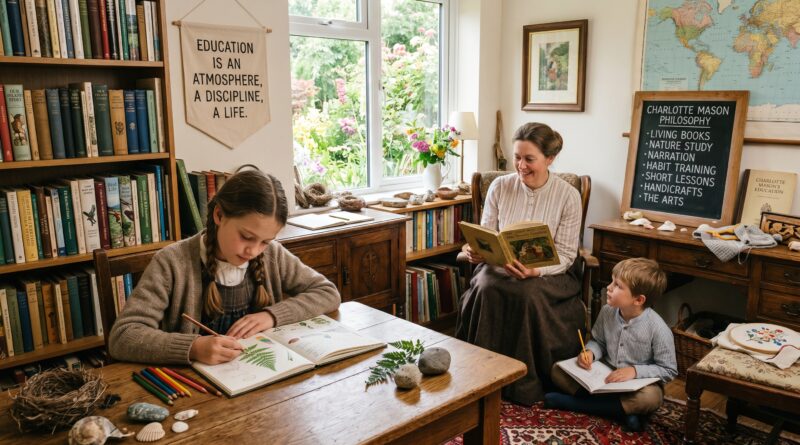
At its core is the motto: “Education is an atmosphere, a discipline, and a life.” This means children learn through the rich environment around them, the formation of good habits, and exposure to “living ideas” found in high-quality books and real experiences.
Mason distilled her philosophy into 20 Principles, which emphasize respect for the child’s personality, the power of narration after a single reading, nature study, short focused lessons, a broad curriculum of “living books,” and the unity of intellectual and spiritual growth.
Today, thousands of homeschool families worldwide use this method because it fosters deep attention, a love of learning, strong character, and broad knowledge without reliance on dry textbooks, rewards, or excessive testing. It is not a rigid curriculum but a way of seeing education as the formation of the whole person.
Who Was Charlotte Mason and Why Her Ideas Endure
Charlotte Mason was a teacher, lecturer, and educational reformer who spent decades observing children and refining her methods through the Parents’ National Educational Union (P.N.E.U.), which she helped establish. Her six-volume Home Education Series (public domain and freely available) remains the primary source for her thought.
She lived in an era when many viewed education through the lens of class, heredity, or mechanical drills. Mason rejected these. She argued that all children regardless of background are capable of engaging with great ideas, forming strong habits, and directing their own learning when given the right conditions.
In my experience working with families who adopt Charlotte Mason methods, one of the most consistent observations is how quickly children’s attention spans lengthen and their natural curiosity reawakens once dry worksheets and constant testing are set aside. Parents often report that their children begin requesting more reading and spontaneously connecting ideas across subjects exactly what Mason predicted when education becomes “a life.”
The Heart of the Philosophy: Atmosphere, Discipline, and Life
Mason’s famous motto captures the three primary “instruments” of education (Principle 5):
- Education is an Atmosphere: Not an artificial “child-centered” bubble, but the real home environment—conversations, books on shelves, nature walks, music playing, art on walls, and the quiet example of parents who love learning themselves. Children absorb the tone and values of their surroundings.
- Education is a Discipline: The steady training of habits. Mason believed habits literally shape the brain and character. Good habits (attention, obedience, cleanliness, perseverance) make right action easier over time; bad habits do the opposite. Training is gentle, consistent, and opportunity-based rather than punitive.
- Education is a Life: The mind feeds on ideas the way the body feeds on food. Children need a generous feast of living ideas from literature, history, science, art, and nature—not pre-digested facts or “twaddle.”
These three work together. A rich atmosphere supports habit formation, and both make the mind ready to receive and relate to living ideas.
Mason also spoke of “the Science of Relations” helping children form personal connections with the world of knowledge, people, and God rather than accumulating isolated facts.
The 20 Principles of Charlotte Mason
Here is the complete list in an accessible modern rendering (based closely on Mason’s original wording from the preface to Volume 6 of her Home Education Series, with phrasing clarified for contemporary readers while preserving her meaning). These principles build logically upon one another.
- Children are born persons. They are not blank slates or potential persons they already possess full personhood, dignity, and capacities.
- They are not born either good or bad, but with possibilities for good and for evil. Children have a sin nature yet can choose well when guided rightly; environment and training matter.
- The principles of authority on the one hand, and of obedience on the other, are natural, necessary and fundamental. Order in family and society depends on rightful authority willingly followed.
- These principles are limited by the respect due to the personality of children. Adults must not manipulate children through fear, excessive affection, suggestion, or undue influence that overrides their will.
- Therefore, we are limited to three educational instruments the atmosphere of environment, the discipline of habit, and the presentation of living ideas.
- When we say that “education is an atmosphere,” we do not mean that a child should be isolated in what may be called a “child-environment”… but that we should take into account the educational value of his natural home atmosphere.
- “Education is a discipline” means training in habits of body and mind so that right action becomes natural.
- “Education is a life” means the mind requires a varied diet of living ideas across many subjects for full intellectual, moral, and physical growth.
- The child’s mind is not a receptacle to be filled but a living spiritual organism with an appetite for all knowledge. It digests ideas naturally, like the stomach digests food.
- We reject the notion that the mind is an empty stage or that education depends primarily on the teacher’s elaborate preparation. Children can handle real knowledge directly.
- Children’s minds are capable of dealing with real knowledge; therefore we offer a rich, generous curriculum full of vital, connected ideas rather than simplified fragments.
- Education is the science of relations. Children naturally form connections between ideas, nature, art, people, and God when given wide opportunities.
- In planning curriculum we provide much knowledge, variety to prevent boredom or mental weariness, and literary language that engages attention.
- Knowledge is not truly possessed until it is expressed; therefore children narrate (tell back) what they have read or heard.
- Children should narrate after a single reading or hearing. Their natural power of attention is strong; repeated readings or teacher summaries weaken it and waste time.
- Children have two guides for moral and intellectual growth the way of the will and the way of reason.
- In the way of the will, children learn to distinguish “I want” from “I will” and use diversion of thought to strengthen resolve when tempted.
- In the way of reason, children learn not to lean too heavily on their own reasoning, which can justify almost any desired conclusion.
- The chief responsibility of education is to teach children how to accept or reject ideas wisely, supported by good habits and broad knowledge.
- We teach that all truths are God’s truths. There is no separation between sacred and secular subjects; the Divine Spirit aids in every area of life and learning.
Applying the Principles in Practice Today
When families implement these ideas, several distinctive practices emerge:
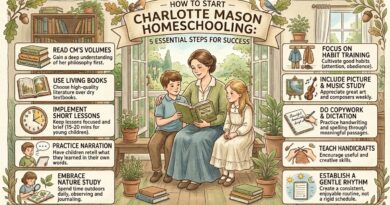
Living Books replace textbooks. Children read (or hear) real literature Little House on the Prairie, The Story of the World, biographies, Plutarch, great poetry and narrate it.
Narration is the primary “test.” After one reading, the child tells back the story or information in their own words. This builds attention, comprehension, memory, and the ability to synthesize. Written narration develops later.
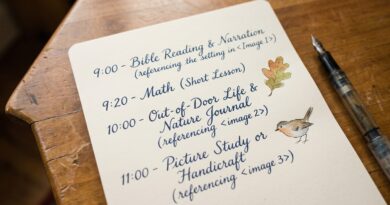
Short Lessons protect attention and joy. Young children do 10–20 minute lessons; older students up to 45 minutes. Afternoons are often free for nature study, handicrafts, or personal interests—no heavy homework that steals family time.
Nature Study and Journals connect children directly with the created world. Weekly nature walks, careful observation, drawing, and descriptive writing replace or supplement formal science in the early years.
Habit Training is intentional but gentle. Parents choose one or two habits at a time (e.g., “full attention when spoken to” or “putting things away immediately”) and provide consistent opportunities and reminders until the habit forms.
Picture Study, Composer Study, and Copywork add beauty and skill. Children study one great painting or composer for several weeks, learning to see and hear with discernment. Copywork improves handwriting, spelling, and attention to beautiful language.
Wide but Not Deep Curriculum introduces many subjects lightly so children develop “the science of relations.” History, literature, science, geography, art, music, Bible, and nature all appear regularly rather than one subject dominating for months.
These practices flow directly from the 20 Principles and create an education that feels alive rather than mechanical.
Benefits and Realistic Challenges
Benefits families commonly report include stronger attention and memory, genuine love of learning that persists into adulthood, improved character and self-management through habit training, broad general knowledge, and closer family relationships built around shared stories and nature time. Many CM-educated students transition well to college because they already know how to learn independently and engage with complex texts.
Challenges include the parent’s need to read ahead and curate living books (though excellent free and affordable resources now exist), the initial adjustment period when children accustomed to entertainment-style learning resist narration, and the reality that progress is sometimes harder to “measure” on standardized tests in the early years (though long-term academic outcomes are strong). Some families find it requires more parental investment than boxed curricula. It also assumes a degree of consistency; sporadic implementation yields weaker results.
The philosophy is flexible. Many families combine it successfully with classical elements, Charlotte Mason-style math programs, or specific high school needs while staying rooted in the principles.
Conclusion
Charlotte Mason’s 20 Principles offer far more than a homeschool method they present a respectful, hopeful vision of childhood and education. By treating children as persons, feeding their minds with living ideas, training habits that free the will, and surrounding them with an atmosphere of truth and beauty, we cooperate with the natural and spiritual laws of growth.
In a world of screens, fragmented attention, and pressure to perform, this philosophy provides a refreshing alternative: education that forms character, ignites wonder, and equips young people to think clearly and live well. It is not the easiest path nothing worthwhile usually is but it is deeply rewarding for both children and parents.
Whether you adopt it fully or borrow elements that resonate, engaging with Charlotte Mason’s thought will likely change how you see your children and the possibilities of their education. Start with the principles themselves, experiment gently with narration and living books, and watch what happens when a child’s mind is treated as the living, hungry organism it truly is.
FAQs
Is the Charlotte Mason philosophy only for Christian families?
No. While Mason’s own worldview was Christian and Principle 20 reflects that, the practical methods—living books, narration, habit training, nature study have been used effectively by secular, Jewish, Catholic, and other families. The emphasis on ideas and personhood transcends any single faith tradition.
How does it work for high school?
Very well. Older students continue narration (now often written or discussed at a deeper level), tackle original sources, keep common-place books, pursue personal projects, and maintain nature study or handicrafts. Many add community college dual enrollment or apprenticeships while preserving the relational, idea-rich core.
Do children still learn math, grammar, and other “basics”?
Yes. Mason advocated careful, short lessons in these areas using living methods where possible (e.g., mathematical reasoning through real problems rather than endless drills). Many modern CM families use programs like Math-U-See, RightStart, or MEP alongside the philosophy.
What if my child has ADHD, dyslexia, or other learning differences?
Many families with neurodiverse children find CM helpful because of short lessons, multi-sensory elements (narration + drawing + nature), and emphasis on relationship over performance. Adaptations—such as oral narration longer, audiobooks paired with text, or movement breaks—are common and effective.
How much does it cost?
Very little if you use free resources like Ambleside Online (full curriculum schedules and book lists), Project Gutenberg, or library books. The biggest “cost” is parental time reading and being present.
Can I mix Charlotte Mason with other methods?
Yes. Many families successfully blend CM with classical education, Montessori elements, or interest-led learning. The 20 Principles serve as a filter: Does this practice respect the child as a person? Does it feed the mind with living ideas? Does it build good habits?
Is there homework?
Typically very little or none in the traditional sense.
How do I know if my child is “getting it” without tests?
Narration itself is the assessment. A child who can accurately and expressively retell a story or explain a concept has made it their own. Written work, discussions, nature journals, and the child’s growing enthusiasm are additional indicators.