
What Is Common Core Math and How Does It Work?
Quick Answer Common Core Math refers to the Common Core State Standards for Mathematics (CCSSM), a set of K-12 learning expectations developed in 2010 and still used (or closely adapted) by most U.S. states in 2026. It is not a curriculum, textbook series, or single teaching method. Instead, it outlines what students should know and be able to do at each grade level.
It works by shifting emphasis toward deep conceptual understanding, flexible problem-solving with multiple strategies, visual models, real-world applications, and students explaining their reasoning—rather than rote memorization of procedures. The goal is to build coherent, lasting mathematical knowledge that prepares students for college, careers, and everyday life. In practice, this often means students use number lines, area models, drawings, and discussions alongside (or before) traditional algorithms.
Introduction: Why Parents and Educators Still Need to Understand Common Core Math in 2026
If you’ve ever looked at your child’s math homework and thought, “Why are they drawing all these pictures and boxes instead of just doing the problem the way I learned it?” you’re not alone. Common Core Math has been one of the most discussed—and debated—topics in U.S. education for over 15 years.
Whether your state still officially uses the Common Core standards, has rebranded them, or uses closely aligned expectations, the underlying shifts in how math is taught and learned remain influential in classrooms across the country. Understanding how Common Core Math works helps parents support their children, reduces homework frustration, and clarifies what “good” math instruction looks like today.
In this guide, I’ll explain what Common Core Math actually is, the key principles that drive it, how it plays out in real classrooms with specific examples, its benefits and criticisms, and practical ways families can engage with it. My goal is to give you clear, balanced, and actionable information based on the standards themselves and how they’ve been implemented.
What Exactly Is Common Core Math?
The Common Core State Standards Initiative began in 2009–2010 as a state-led effort by the National Governors Association and the Council of Chief State School Officers. The mathematics standards were designed to address long-standing problems in U.S. math education: a curriculum that was often “a mile wide and an inch deep,” inconsistent expectations across states, and insufficient preparation for college and careers.
Important clarification: Common Core provides standards—clear descriptions of the skills and knowledge students should master by the end of each grade. It does not dictate how teachers must teach or which textbooks or programs schools must use. Districts and teachers choose curricula (such as Eureka Math/EngageNY, Illustrative Mathematics, or others) that align with these standards.
As of 2026, the majority of states continue to use the Common Core framework or very close adaptations, though a handful have modified or moved away from the original name while retaining many of the same expectations. The official standards remain available through corestandards.org.
The standards have two main parts:
- Standards for Mathematical Practice (8 habits of mind that apply across all grades).
- Standards for Mathematical Content (specific grade-by-grade expectations organized by domains like Operations & Algebraic Thinking, Number & Operations in Base Ten, Fractions, Ratios & Proportional Relationships, etc.).
The 8 Standards for Mathematical Practice: The “How” Behind Common Core Math
These eight practices describe the behaviors of mathematically proficient students and are central to how Common Core Math “works” in the classroom:
- Make sense of problems and persevere in solving them.
- Reason abstractly and quantitatively.
- Construct viable arguments and critique the reasoning of others.
- Model with mathematics.
- Use appropriate tools strategically.
- Attend to precision.
- Look for and make use of structure.
- Look for and express regularity in repeated reasoning.
In practice, this means students are encouraged to slow down, draw pictures or use objects to understand a problem, explain their thinking out loud or in writing, listen to classmates’ ideas, and look for patterns. Teachers facilitate discussions rather than simply demonstrating one “correct” method.
Key Shifts in Common Core Math
The standards introduced three major shifts compared to many pre-2010 state standards:
1. Greater Focus Fewer topics are covered each year, but they are taught in greater depth.
- K–2: Deep work on addition and subtraction concepts and fluency.
- 3–5: Multiplication/division of whole numbers and fractions.
- 6: Ratios, proportional relationships, and early algebra.
This contrasts with older approaches that touched on many disconnected topics each year.
2. Coherence Topics are carefully sequenced so new learning builds directly on previous understanding across grades. For example, the way fractions are introduced in grade 3 connects to earlier work with whole-number operations and prepares students for ratios in grade 6.
3. Rigor Balance of three components:
- Conceptual understanding (“why does this work?”)
- Procedural skill and fluency (efficient, accurate methods)
- Application (using math in real-world situations and multi-step problems)
Students are expected to understand why procedures work, not just execute them.
How Common Core Math Works in Practice: Real Examples
Here’s how these ideas show up in everyday math:
Early Elementary (K–2) – Addition Strategies Instead of only teaching the standard algorithm right away, students explore multiple ways to add.
Example: Solve 8 + 5.
- One strategy: Make a ten → 8 + 2 = 10, then 10 + 3 = 13.
- Another: Use a number line or ten-frame to visualize.
- Students might draw circles or use counters, then explain: “I broke the 5 into 2 and 3 so I could make a ten first.”
This builds number sense and flexibility before (or alongside) the traditional “carry the one” method.
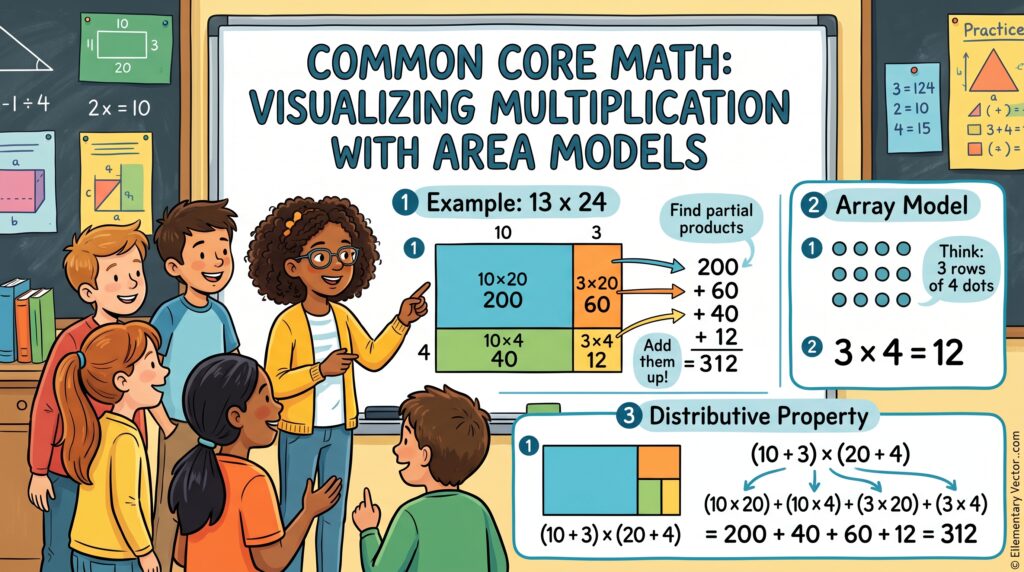
Upper Elementary (3–5) – Multi-Digit Multiplication Students often learn the area model or partial products before or alongside the standard algorithm.
Example: 23 × 45. Students might break it into: (20 × 40) + (20 × 5) + (3 × 40) + (3 × 5) = 800 + 100 + 120 + 15 = 1,035.
They draw a rectangle divided into parts representing these calculations. This helps them see why the algorithm works (place value and distributive property) rather than just memorizing steps.
Fractions (Grades 3–5) Visual models are heavily emphasized. Students use number lines, area models, and tape diagrams to understand equivalence, addition, subtraction, and multiplication of fractions before relying solely on algorithms.
For instance, to solve 2/3 × 4, students might draw a rectangle representing 1 whole, divide it into thirds, shade 2/3, then show that multiplying by 4 means repeating that amount four times or scaling it—leading to the understanding that 2/3 × 4 = 8/3.
Students also explain their reasoning and critique others’ models.
Middle School Greater emphasis on ratios, proportional reasoning, expressions, equations, and statistics. Students model real-world situations (e.g., using tape diagrams for percent problems) and justify solutions.
Throughout, the focus is on students becoming active mathematical thinkers who can choose appropriate strategies, explain their work, and apply math flexibly.
Common Core Math vs. Traditional Math: Key Differences
Many parents notice homework that looks “different.” Traditional approaches often prioritized quick mastery of standard algorithms through repetition. Common Core-aligned instruction typically:
- Introduces visual and conceptual models first.
- Expects students to understand why a method works.
- Values multiple valid strategies.
- Requires more writing and discussion about math.
The standard algorithms are still taught and expected for fluency—they’re just introduced later or alongside deeper understanding so students don’t treat them as mysterious steps.
Benefits and Criticisms: A Balanced View
Benefits
- Builds stronger conceptual foundations and problem-solving skills.
- Encourages mathematical communication and critical thinking.
- Provides more consistent expectations across states and schools.
- Aligns with research on how children learn math effectively (e.g., the importance of visual models and connecting procedures to concepts).
- Many educators report students develop better number sense and flexibility.
Criticisms and Challenges
- Homework can confuse parents who learned math differently, leading to frustration at home.
- Implementation quality varies widely depending on teacher training and curriculum choices.
- Some students (and parents) feel the emphasis on multiple strategies and explanations slows down computation fluency.
- Standardized test results (such as NAEP) have shown mixed or limited overall gains in math proficiency since implementation, though isolating the effect of the standards themselves is difficult.
- Early controversies around specific problems or perceived “overcomplication” fueled political pushback in some states.
In reality, when taught well with strong curriculum and support, the approaches associated with Common Core can be highly effective. When implemented poorly, any set of standards can fall short.
How Parents Can Support Children Learning Common Core Math
- Ask questions instead of correcting immediately: “Can you show me how you got that?” or “What does this picture represent?”
- Embrace the visuals: Drawing models often reveals deeper understanding.
- Focus on the “why”: Help your child explain their thinking.
- Use resources: Khan Academy, Prodigy, or your child’s curriculum’s parent guides often have excellent explanations of strategies.
- Practice fact fluency at home in short, fun ways (games, apps) while the classroom builds conceptual understanding.
- Communicate with teachers: Ask how strategies connect across grades and what the end goal is for fluency.
Many families find that once they understand the “why” behind the methods, homework becomes less stressful and more meaningful.
Current Landscape in 2026
While a small number of states have moved away from or significantly revised the original Common Core standards in recent years, the core ideas—deeper conceptual understanding, coherence across grades, and mathematical practices—continue to shape math instruction in the vast majority of U.S. classrooms. Many states that revised their standards kept very similar expectations. The debate has matured from “Is Common Core good or bad?” to more nuanced discussions about curriculum quality, teacher support, and assessment design.
Conclusion: Moving Beyond the Controversy to What Matters Most
Common Core Math, at its core, is an attempt to give American students a more coherent, focused, and rigorous mathematics education that builds genuine understanding rather than surface-level procedural knowledge. While implementation has been uneven and the public conversation has often been polarized, the underlying goals—students who can think mathematically, solve problems flexibly, and explain their reasoning—remain worthwhile.
For parents, the most helpful approach is to stay curious about what your child is learning and why certain methods are being used. When you understand the bigger picture, you can better support your child’s mathematical growth, whether their classroom uses Common Core, a modified version, or another set of high-quality standards.
Math education continues to evolve. The best outcomes come when standards, curriculum, teaching, and family support work together to help every student develop confidence and competence with numbers and problem-solving.
FAQs
Is Common Core still being used in 2026?
Most states continue to use the Common Core standards or very close versions of them, though a few have made modifications or rebranded their standards.
Does Common Core ban the traditional way of doing math?
No. The standard algorithms are still taught and expected. They are typically introduced after (or alongside) conceptual understanding so students know why they work.
Why does my child have to draw pictures for simple problems?
Visual models help build deep understanding of concepts like place value, fractions, and operations. Once understanding is solid, students move toward more efficient methods.
Is Common Core harder or easier than old math?
It’s different. It often requires more thinking and explanation early on, which some students find challenging at first but rewarding later. Procedural fluency is still a goal.
How can I help if I don’t understand the new methods?
Look at your child’s curriculum resources, watch short explanation videos together, or ask the teacher for a quick overview of the strategy being used.
Does Common Core prepare kids for college?
The standards were explicitly designed with college and career readiness in mind, emphasizing problem-solving, modeling, and reasoning skills valued in higher education and many careers.
Are there assessments tied to Common Core?
Many states use assessments (such as SBAC or state-specific tests) aligned to their standards, which often include performance tasks and constructed responses in addition to multiple-choice questions.
What if my child’s school uses a different approach?
Standards set the “what,” not the “how.” Different curricula and teaching styles can all align with the same standards.