Homeschool History Curriculum By Using Living Books
Quick Answer Yes using living books is one of the most effective and joyful ways to teach homeschool history. Rooted in Charlotte Mason’s philosophy, this approach replaces dry textbooks with well-written narrative books by passionate authors. Children engage deeply through reading (or listening), followed by narration — retelling the story in their own words. The result is stronger retention, improved language skills, critical thinking, empathy, and a genuine love for history instead of temporary memorization for tests.
It works beautifully for multi-age families, supports both American and world history, and can be implemented with free public-domain resources, library books, or affordable guides from providers like Ambleside Online, Simply Charlotte Mason, or Beautiful Feet Books. Short daily lessons (15–30 minutes), timelines, map work, and discussion keep it manageable and relational. Many families report that children remember events, people, and ideas years later because history “comes alive” through story.
Introduction: Why History Feels Different with Living Books
History often gets a bad reputation in traditional schooling endless lists of dates, battles, and presidents to memorize, then quickly forget. In homeschool settings, parents frequently search for something better: a method that builds real understanding, connects the past to the present, and nurtures curiosity rather than compliance.
Living books solve this beautifully. These are not simplified textbooks written by committees. They are single-author works rich in literary quality, vivid storytelling, and big ideas. When children meet history through the eyes of a skilled narrator — whether following the Pilgrims in A Lion to Guard Us, walking with George Washington in Genevieve Foster’s books, or experiencing the American Revolution through Johnny Tremain — they form personal connections. They don’t just learn about history; they begin to live it in their imaginations.
This guide draws from Charlotte Mason’s principles, practical experience with hundreds of homeschool families, and time-tested resources. Whether you’re new to homeschooling, transitioning from textbooks, or refining a Charlotte Mason-inspired approach, you’ll find clear steps, book recommendations, sample schedules, honest pros and cons, and answers to common questions. The goal is not perfection or covering every possible fact, but raising thoughtful young people who understand the human story and their place in it.
What Are Living Books?
Charlotte Mason (1842–1923), a British educator whose ideas have profoundly influenced homeschooling worldwide, distinguished “living books” from what she called “twaddle” or dry compilations. A living book is written by one author who cares deeply about the subject and possesses the gift of storytelling. It presents worthy ideas in engaging language, sparks imagination and emotion, and leaves the reader changed.
Key characteristics include:
- Narrative or literary style — Stories, biographies, or firsthand-inspired accounts rather than bullet-point facts.
- Single author voice — Personal passion and perspective instead of committee-approved neutrality that often strips out life.
- Rich ideas — Content that prompts thinking about courage, liberty, justice, leadership, or human nature.
- Age-appropriate depth — Simple and vivid for younger children; more complex primary sources and analysis for older students.
- Moral imagination — Inspires virtue indirectly through example, without heavy-handed preaching.
For history specifically, living books include sweeping narratives like H.E. Marshall’s This Country of Ours or Our Island Story, biographies, well-researched historical fiction, and (for high school) letters, speeches, and classic accounts. Textbooks, by contrast, often prioritize coverage and testability over connection. Children may pass a quiz but retain little long-term because the information never truly “lived” in their minds.
In practice, families using this method notice children voluntarily bringing up historical figures in conversation, drawing parallels to current events, or asking to read “just one more chapter.” That relational quality is the heart of the approach.
The Charlotte Mason Foundation for History Study
Charlotte Mason viewed education as “the science of relations.” Children naturally form connections when knowledge is presented attractively. History plays a central role because it shows how people lived, decided, struggled, and shaped the world we inherit.
Her method for history includes:
- Living books as the core.
- Narration — The child retells what was read or heard, training attention, comprehension, and expression. Narration is “the act of knowing.”
- Short lessons — 10–20 minutes for younger children, building concentration without fatigue.
- Chronological study — Usually in cycles so children encounter the same eras at increasing maturity.
- Active tools — Book of Centuries (a personal timeline notebook), map work, and occasional picture study or period poetry/music.
- Wide reading — Multiple books per term rather than one exhaustive text.
Ambleside Online (a free Charlotte Mason curriculum) organizes history in two six-year chronological cycles across 12 years, emphasizing Western civilization with strong attention to British and American roots. Families can start mid-cycle and still succeed because the priority is kindling interest and building a mental framework.
Simply Charlotte Mason and Beautiful Feet Books offer structured guides with living books, discussion questions, and gentle activities — excellent on-ramps for parents who want support without reinventing the wheel.
Benefits of Using Living Books for Homeschool History
Deeper retention and understanding When children narrate, they must synthesize and re-express ideas. This cognitive work creates stronger memory traces than passive reading or worksheet completion. Families routinely share that events studied years earlier still surface in conversations.
Language and thinking skills Exposure to beautiful prose improves vocabulary, sentence structure, and narrative ability. Narration itself is oral composition practice that transfers directly to writing.
Emotional and moral development History becomes peopled with real humans facing dilemmas. Children develop empathy, admire courage, question poor decisions, and reflect on themes like liberty, justice, and perseverance — all without didactic lectures.
Multi-age and family-friendly One read-aloud can serve a wide age range. Younger children absorb atmosphere and story; older ones add analysis. This builds family culture and reduces the need for separate programs.
Flexibility and joy Lessons stay short. You can linger on fascinating topics or move on. Many parents report rediscovering their own love of history alongside their children.
Preparation for life and academics The method cultivates attention, discernment, and the ability to learn independently — skills that serve students whether they pursue college, trades, or entrepreneurship. High schoolers who have narrated for years often transition smoothly to primary-source analysis and essay writing.
Potential Challenges and How to Overcome Them
No method is perfect for every family. Honest awareness helps.
Book acquisition and cost Living books can add up. Solutions: Use Project Gutenberg, Internet Archive, and Librivox for hundreds of free public-domain titles and audiobooks. Shop used via ThriftBooks or homeschool swaps. Many libraries carry popular reprints. Start with one spine book and a few supporting titles.
Parent time for reading aloud and listening to narrations Busy seasons happen. Rotate read-aloud duties with a spouse or older sibling. Use quality audiobooks for independent listening followed by narration. Some families do history three or four days a week instead of daily.
Perceived gaps in “coverage” Textbooks promise to mention everything; living books go deep on what matters. Children often end up with broader knowledge because they retain what they read and make connections across books. Supplement strategically with timelines and occasional reference books rather than switching methods.
Reluctant narrators or children who struggle with oral/written expression Start gently. Model narration yourself first. Allow drawing, acting out scenes, or telling to a stuffed animal for young or shy children. Keep expectations age-appropriate — a five-year-old’s narration will be simpler than a ten-year-old’s.
Transition to high school rigor or standardized testing The foundation of wide reading and narration prepares students well. Add more primary sources, formal essays, and discussion of historiography in high school. Many families blend living books with targeted test-prep materials when needed.
Parent burnout or feeling “behind” Trust the process for a term or two before judging. Join supportive communities (Ambleside Online forums, Simply Charlotte Mason groups, or local co-ops) for encouragement and book swaps.
How to Build Your Homeschool History Curriculum with Living Books
Step 1: Clarify your goals and scope Do you want a strong American history focus with world history woven in, or a full chronological world history cycle? Most U.S. homeschoolers do both over time. Decide on a loose cycle (e.g., four or six years repeating with increasing depth) or follow a ready-made plan like Ambleside Online Years 1–6 or 7–12.
Step 2: Select spines and supporting living books A “spine” provides the overarching narrative; supporting books add depth through biography or focused stories. Excellent American history spines include This Country of Ours by H.E. Marshall. World history favorites include Our Island Story or selections from The Story of Mankind.
Step 3: Set a sustainable rhythm Most families do history 3–5 days per week for 15–30 minutes. Read a chapter (or portion), narrate immediately, discuss one or two thoughtful questions, and occasionally add to a timeline or map. Keep lessons short to protect attention and joy.
Step 4: Incorporate narration, timelines, and map work Narration happens after every reading. For younger children: oral. For older: mix oral and written. The Book of Centuries (a blank or lightly structured timeline book) lets students actively record what they’re learning — far more effective than passive worksheets. Map work can be as simple as tracing routes or labeling key locations on outline maps.
Step 5: Adapt for ages and learning styles
- Elementary (approx. 6–10/11): Heavy read-alouds, simple narration, picture books and biographies, basic timeline entries.
- Middle school (approx. 11–14): Mix read-aloud and independent reading, longer narrations, more map and timeline work, beginning discussion of cause/effect and character.
- High school (approx. 14–18): More independent reading, written narration/essays, primary sources, comparison of historical accounts, and connections to government, economics, and philosophy.
Recommended Living Books and Resources
Strong spines and core books (widely loved and CM-friendly)
- This Country of Ours by H.E. Marshall — Excellent American history spine.
- Our Island Story by H.E. Marshall — Engaging introduction to British history that many U.S. families use.
- Genevieve Foster’s “World” books (George Washington’s World, Abraham Lincoln’s World, etc.) — Beautifully connect events and people across continents.
- A Lion to Guard Us by Clyde Robert Bulla — Pilgrim story, perfect for younger readers.
- Johnny Tremain by Esther Forbes — Vivid Revolutionary War historical fiction.
- Across Five Aprils by Irene Hunt — Civil War through a boy’s eyes.
- Biographies by Russell Freedman or Jean Fritz — Accessible and well-researched for elementary/middle grades.
- D’Aulaire illustrated biographies — Charming for younger children.
Helpful curriculum supports
- Ambleside Online (free detailed booklists and schedules at amblesideonline.org)
- Simply Charlotte Mason history guides (family-style with age-appropriate readings)
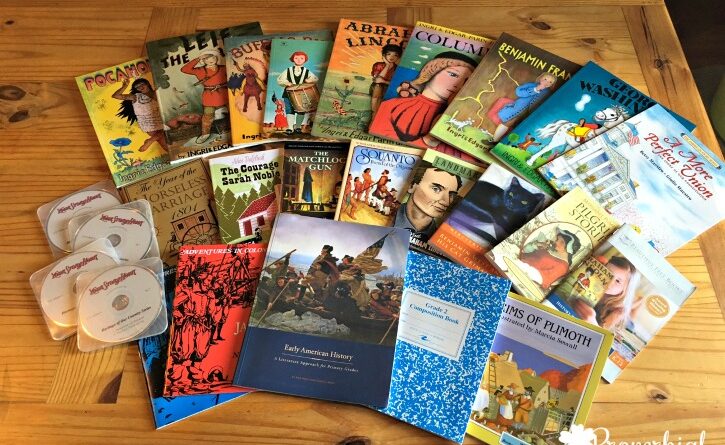
- Beautiful Feet Books packs (living books + gentle study guides with discussion questions)
- Living Books Press or Yesterday’s Classics reprints for quality editions
For high school, supplement with primary sources (speeches, letters, foundational documents) and select classic narratives. Many families also enjoy The Story of the World series by Susan Wise Bauer as a bridge or additional spine.
Build your home library gradually. Start with a spine and two or three supporting titles per term.
Sample Weekly Rhythm (Mixed-Age Family Example)
Monday–Wednesday 15–25 minutes: Read from spine or core living book together. Narrate (oral for younger, oral + brief written for older). One discussion question: “What surprised you?” or “How did this person show courage (or poor judgment)?”
Thursday Map work or timeline addition. Review previous week’s entries. Optional: short related poem or song from the period.
Friday Choice day — extra biography, hands-on project (simple colonial craft, period cooking), library visit, or nature walk tied to historical land use. Or catch-up reading.
Adjust length and independence as children mature. High schoolers may read more independently and write short reflections or essays on themes such as “How did ideas about liberty develop from the colonial period through the founding era?”
Supplementing Living Books Wisely
Living books form the heart; thoughtful supplements enrich without diluting. Consider occasional documentaries, virtual museum tours, or field trips to historic sites. For state history requirements, add targeted living books or biographies about your state’s key figures and events. Avoid overloading the schedule — the power lies in unhurried engagement with excellent books.
Assessing Progress
You won’t need weekly quizzes. Instead, notice:
- Quality and detail of narrations over time
- Ability to place events in sequence and make connections
- Willingness to discuss ideas and ask thoughtful questions
- Growth in written expression (through narration and later essays)
- Retention months or years later
Portfolios of timeline work, maps, and selected written narrations provide beautiful documentation for records or evaluations. For high school transcripts, you can assign meaningful grades based on engagement, depth of understanding, and written work.
Conclusion
Homeschooling history with living books is more than an academic strategy it is an invitation to relationship. Your children meet real people who faced real challenges, made decisions with consequences, and left legacies that still shape our lives. Through story, narration, and reflection, history moves from abstract dates on a page to living ideas that inform character, citizenship, and wisdom.
You don’t need to be a history expert or have a perfect plan to begin. Choose one excellent living book, read it together, and let your child tell it back to you. Do that consistently for a term and you will likely see the difference in engagement, retention, and joy.
History is the story of humanity — our failures, our courage, our creativity, and our ongoing quest to live well together. When we give our children living books, we give them the chance to enter that story personally and carry its lessons forward.
Start today. The past is waiting to come alive in your home.
FAQs
What age should we start using living books for history?
You can begin as early as kindergarten or first grade with simple picture-book biographies and stories. Formal narration and timelines usually begin around age 6–7 and grow in sophistication.
Do I need to buy a full curriculum or can I create my own booklist?
Both work. Ready guides from Simply Charlotte Mason or Beautiful Feet Books save planning time and ensure quality selections. Ambleside Online offers completely free, detailed plans. Many experienced families mix and match.
How does this prepare students for college or standardized tests?
The habits of attention, synthesis through narration, wide reading, and clear expression serve students exceptionally well. High schoolers add more analytical writing and primary-source work. Families report strong performance on AP history exams and college-level reading when the foundation is solid.
Is the Charlotte Mason approach religious?
Mason was a committed Christian, and some resources reflect that worldview. However, the method itself — living books, narration, short lessons — is adaptable. Many secular families use it successfully by choosing appropriate titles and focusing on the educational principles.
What if my child hates narration or struggles with it?
Start small and model it. Use drawing, acting, or telling the story to a pet as bridges. Keep lessons short. Most children grow into it; the skill develops with practice and low pressure.
How do we handle recent or current history?
Continue the chronological cycle into the 20th and 21st centuries with living books, biographies, and primary sources. Supplement with thoughtful discussion of current events in light of historical patterns.
Can we combine this with other history resources or co-ops?
Absolutely. Many families use living books as the core and add a once-a-week co-op, online class, or unit study for variety. The key is protecting the depth and relational quality of the living books time.
Is this method expensive?
It can be budget-friendly. Prioritize free public-domain books and library resources first. Many core spines are available in affordable reprints or used copies. One or two well-chosen guides per year often suffice.