Colorado Homeschool Laws
Quick Answer Yes, homeschooling is fully legal in Colorado. Families have three clear legal pathways:
- File an annual Notice of Intent (NOI) with any Colorado school district and follow the home-based education statute (most popular option).
- Enroll your child in a qualifying independent or umbrella private school (no NOI required).
- Hold a current Colorado teaching license (simplest compliance).
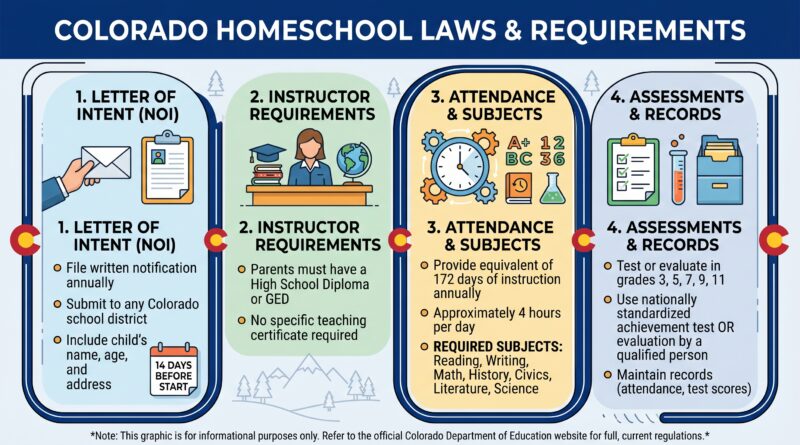
Under the most common pathway, you must provide at least 172 days of instruction averaging 4 hours per day, cover specific core subjects, keep basic records, and arrange an assessment or evaluation in grades 3, 5, 7, 9, and 11. Colorado is considered a moderately regulated but parent-friendly state that respects family educational freedom while ensuring basic accountability. This guide walks you through everything with practical steps, comparisons, and resources so you can choose the path that fits your family best.
Important Disclaimer: This article provides general information based on Colorado Revised Statutes § 22-33-104.5 and resources from the Colorado Department of Education (CDE) as of mid-2026. It is not legal advice. Education laws can be updated, and individual situations vary. Always verify current requirements directly with the Colorado Department of Education, your chosen school district, or organizations such as the Home School Legal Defense Association (HSLDA) or Christian Home Educators of Colorado (CHEC). Consult a qualified attorney for personalized guidance, especially if your child has special needs, a history of truancy, or if you are transitioning mid-year.
Introduction: Why Colorado Parents Choose Homeschooling
Colorado families turn to homeschooling for many reasons: personalized pacing, stronger family bonds, protection from bullying or excessive testing, religious or philosophical convictions, or simply the desire for more flexibility in a beautiful state with abundant outdoor learning opportunities.
The Centennial State has a long tradition of educational choice. Homeschooling in its modern form has been explicitly protected since 1988. While not as unregulated as some states, Colorado strikes a balance that gives parents significant autonomy while maintaining modest oversight through notice, basic instructional standards, and periodic progress checks.
In practice, thousands of Colorado children thrive in home-based education each year. Many families report deeper relationships, customized learning that matches their child’s strengths and challenges, and strong academic outcomes—often outperforming state averages on college entrance exams and in postsecondary success. The key to success is understanding the rules upfront so compliance becomes a simple routine rather than a source of stress.
The Three Legal Pathways to Homeschool in Colorado
Colorado law recognizes three distinct options. You cannot combine the NOI pathway with independent school enrollment in a way that creates conflicting obligations—choose one primary framework.
Pathway Comparison at a Glance
| Aspect | Option 1: Home-Based Education (NOI) | Option 2: Independent/Umbrella Private School | Option 3: Colorado Licensed Teacher Parent |
|---|---|---|---|
| Notice Required | Annual NOI to any district, 14 days prior | None to district | None |
| Teacher Qualification | Parent/guardian/adult relative | Parent actively involved (per school policy) | Current Colorado teaching license |
| Instructional Time | 172 days, avg. 4 hrs/day | 172 days (no hourly average) | No specific mandate |
| Required Subjects | Yes (detailed below) | Similar core subjects + school policies | General compulsory attendance only |
| Assessment | Grades 3,5,7,9,11 (test or eval) | Often odd years or per school schedule | None required |
| Record Keeping | Attendance, tests/evals, immunizations | Per school requirements | Minimal |
| Best For | Families wanting maximum independence | Families wanting support, transcripts, community | Licensed teachers seeking simplicity |
| District Interaction | Direct (or name umbrella for results) | Minimal | Minimal |
Option 1: The Home-Based Education Program (Most Common Choice)
This is the pathway most pure homeschool families use. It treats your home as a “non-public home-based educational program” under CRS § 22-33-104.5.
Step-by-Step to Get Started
-
Decide your start date and choose a district You may file with any school district in Colorado—not necessarily the one where you live. Many families select a convenient or homeschool-friendly district. File at least 14 days before you begin instruction.
-
Prepare and submit your Notice of Intent (NOI) The NOI is a simple written notice containing:
- Each child’s name and age
- Place of residence
- Number of hours of attendance planned for each child
You may optionally name an independent or parochial school (such as CHEC) to receive assessment results instead of the district. Send via certified mail with return receipt requested for proof. Renew every year.
-
Provide instruction for 172 days averaging 4 hours per day Instruction must be sequential and provided by a parent, guardian, or adult relative designated by the parent. The 172-day requirement can be prorated if you start mid-year.
-
Cover the required subjects (see dedicated section below).
-
Keep records and prepare for assessments (detailed later).
-
Submit assessment results in the required grades to the district or the school you named in your NOI.
Practical Tip from Families: Many Colorado homeschoolers create a simple one-page NOI template and keep a digital folder with the certified mail receipt, yearly NOIs, attendance logs, and test reports. This system makes annual renewal and any potential district request straightforward.
Required Subjects and Instructional Approach
Colorado law requires instruction in:
- Communication skills (reading, writing, and speaking)
- Mathematics
- History
- Civics
- Literature
- Science
- Regular courses of instruction in the United States Constitution
There is no state-approved curriculum list. You have complete freedom to choose materials that match your child’s learning style—classical, Charlotte Mason, project-based, unschooling (with structure to meet subject requirements), online programs, co-ops, or a blend. The law focuses on what is taught, not how or with which specific textbooks.
Attendance, Time Requirements, and Record-Keeping Best Practices
Time: 172 days per year with an average of four instructional hours daily. “Average” allows flexibility—some days longer, some shorter—as long as the yearly average meets the standard. Documenting days and approximate hours in a simple log satisfies most needs.
Records You Must Maintain:
- Attendance (days and hours)
- Results of any tests or evaluations
- Immunization records or exemptions
These records belong to you. A school district superintendent may request them only with 14 days’ written notice and if there is probable cause to believe your program is not in compliance. Routine or fishing expeditions are not permitted. Families who keep clear, organized records (even a simple binder or digital folder) rarely encounter issues.
Experience Note: Parents who treat record-keeping as a light but consistent habit—perhaps a 5-minute end-of-week review—report it becomes second nature and provides valuable documentation for high school transcripts or college applications later.
Assessments and Evaluations: Grades 3, 5, 7, 9, and 11
This is the main accountability checkpoint under the NOI pathway.
You have two options for each required grade:
Option A – Nationally Standardized Achievement Test Administer a nationally normed test (examples: Iowa Test of Basic Skills/ITBS, Stanford Achievement Test, California Achievement Test/CAT, TerraNova, NWEA MAP Growth, or CLT for older students). Your child’s composite score must be above the 13th percentile. State tests like CMAS do not fulfill this requirement.
Option B – Evaluation by a Qualified Person Have a qualified evaluator (Colorado licensed teacher, teacher at an independent/parochial school, licensed psychologist, or individual with a master’s degree or higher in education) assess your child’s academic progress. The evaluation must show progress commensurate with the child’s ability.
Results go to the district that received your NOI or to an independent/parochial school you named in the NOI. Many families name CHEC or a similar organization to keep results out of the public school system while still complying.
Timing: Assessments occur when the child reaches those grade levels (typically in the spring of the relevant school year).
Practical Insight: Some families test every required year for consistency and portfolio building; others use professional evaluations for a more holistic view, especially for children who don’t test well. Both are valid.
Option 2: Enrolling in an Independent or Umbrella Private School
If you prefer support, community, transcripts, and less direct interaction with a district, enrolling in a Colorado independent school (sometimes called an umbrella school) is an excellent alternative.
Popular examples include CHEC Independent School and similar organizations. You follow the school’s policies rather than the NOI statute directly. Requirements often include submitting attendance records to the school by a deadline, following their testing/evaluation schedule (frequently more flexible—odd calendar years for grades 3–12), and maintaining parent-directed instruction with active involvement.
Advantage: Many families appreciate the built-in community, graduation support, and clear record-keeping systems. You avoid filing an NOI with a district altogether.
Important: Do not file both an NOI and enroll in an independent school in a way that creates dual compliance burdens. Choose one framework.
Option 3: Parent Holds a Current Colorado Teaching License
If you (or your spouse/partner) maintain a current Colorado teaching license, you can homeschool under the licensed-teacher exemption with virtually no additional reporting, testing, or specific time/subject mandates beyond general compulsory attendance laws. This is the simplest path for qualified families but requires maintaining the license.
High School, Graduation, and Postsecondary Transitions
Colorado does not issue state diplomas to homeschooled students. The parent (or umbrella school) determines graduation requirements and issues the diploma.
Successful transitions typically include:
- A strong transcript showing courses, grades, and credits
- ACT, SAT, or CLT scores
- Portfolio of work or college-level projects
- Community college dual enrollment (possible in many districts)
Colorado colleges and universities are accustomed to homeschool applicants and evaluate them holistically. Many homeschool graduates thrive in higher education.
Extracurricular Activities, Sports, and Part-Time Public School Enrollment
Homeschooled students have rights to participate in public school extracurriculars and interscholastic activities under certain conditions, generally through the district that received your NOI. Part-time public school enrollment is also possible in many districts, subject to space and policy. Check directly with the district for current rules, as participation often requires meeting the same eligibility standards as enrolled students.
Common Challenges and How Families Overcome Them
- Finding community: Colorado has robust local co-ops, park days, sports leagues, and statewide groups like CHEC.
- High school credits and transcripts: Umbrella schools or simple portfolio systems work well.
- Special needs or gifted learners: You have full flexibility to tailor pace and methods; many families combine homeschooling with therapies or enrichment.
- Burnout or isolation: Building in co-op days, outdoor time, and parent support networks makes a huge difference.
In my experience guiding families, the most successful long-term homeschoolers view the legal requirements as a light annual rhythm rather than a burden—file the NOI once a year, keep a simple log, schedule the assessment when due, and focus the rest of their energy on joyful, effective learning.
Helpful Resources
- Colorado Department of Education Homeschool Page: ed.cde.state.co.us/choice/homeschool (general information and district links)
- Christian Home Educators of Colorado (CHEC): chec.org – excellent practical guides, NOI templates, independent school option, and testing support
- Home School Legal Defense Association (HSLDA): hslda.org/legal/colorado – legal information and membership advocacy
- Full Statute: Colorado Revised Statutes § 22-33-104.5 (searchable on Colorado General Assembly or FindLaw sites)
- Local homeschool groups and co-ops via Facebook or CHEC directories
Note on 2026 Legislative Context: Recent legislative activity focused on publicly funded homeschool enrichment programs (such as certain ERBOCES offerings) and imposed new geographic and eligibility restrictions. Core private homeschool rights under the statute remain stable and unaffected for families using traditional home-based or independent school pathways.
Conclusion
Colorado offers families meaningful educational freedom paired with straightforward, reasonable expectations. Whether you choose the independence of the NOI pathway, the community support of an umbrella school, or the simplicity of a teaching license, the state respects your primary role as your child’s educator.
The most important factors for success are not perfection in paperwork but consistency, genuine engagement with your children’s learning, and a supportive community. Thousands of Colorado families are proving every day that home-based education works beautifully when parents are informed and intentional.
Start with the pathway that feels right for your family, file your NOI or enroll as needed, keep simple records, and then pour your energy into the joyful, customized education your children deserve. Colorado’s mountains, open spaces, and vibrant homeschool networks provide an ideal backdrop for this rewarding journey.
If you have specific questions about your situation, reach out to CHEC, HSLDA, or your chosen district for the most current guidance. You’ve got this.
FAQs
Do I need a teaching certificate to homeschool in Colorado?
No, unless you choose the licensed-teacher pathway. Parents without certification may use the NOI or independent school options.
Can I file my NOI with any district?
Yes. You are not required to use your resident district.
What happens if I start homeschooling mid-year?
You can prorate the 172-day requirement based on the remaining school year.
Are there any required standardized tests like CMAS?
No. Homeschool students are exempt from state public school assessments. You only need the specific progress evaluation or nationally standardized test in the designated grades.
How do I handle high school transcripts and diplomas?
You (or your umbrella school) create and maintain transcripts. Many families use simple templates or services; colleges accept well-documented homeschool records.
Can my child participate in public school sports or activities?
Often yes, through the district that received your NOI, subject to eligibility rules. Confirm current policy with the district.
What if my child has special needs?
Homeschooling allows maximum customization. You may access some public services or therapies depending on district policies; many families combine homeschooling with private therapies or evaluations.
Do I have to teach every subject every day?
No. You must cover the required subjects over the course of the year in a sequential program. Flexibility in scheduling is one of homeschooling’s strengths.
How private are my records?
Very private. Districts have limited access only with probable cause and proper notice. Many families name an umbrella school to receive assessment results instead.
Can I use online programs or co-ops?
Absolutely. Many families blend online curricula, local co-ops, tutors, and parent-led instruction while meeting the legal requirements.