How Old Are Third Graders? Age vs Grade Guide
Quick Answer Third graders in the United States are typically 8 to 9 years old. Most children enter kindergarten at age 5 (based on their state’s birthday cutoff date) and advance one grade each year. By third grade, this usually places them at 8 turning 9 or 9 turning 10 during the school year. While this is the standard range across the vast majority of U.S. public schools, exact placement can vary due to state laws, individual readiness, grade retention, acceleration, or family circumstances. The focus in third grade shifts from “learning to read” to “reading to learn,” making developmental readiness just as important as chronological age.
Introduction
Parents and educators frequently ask, “How old are third graders?” because age and grade level significantly influence expectations, curriculum pacing, social dynamics, and a child’s overall school experience. Third grade marks a pivotal transition in elementary education — a year when academic demands increase, abstract thinking begins to emerge, and children start applying foundational skills to more complex learning.
Understanding the typical age range helps parents set realistic expectations, advocate effectively during parent-teacher conferences, and support their child’s unique developmental timeline. It also highlights why some children thrive while others may need extra support or enrichment, even within the same classroom.
This comprehensive guide draws on educational research, developmental milestones from trusted sources, and practical insights from classroom experience to give you clear, actionable information. Whether your child is on the younger or older end of the spectrum, or you’re navigating questions about readiness, retention, or acceleration, you’ll find balanced, people-first guidance here.

Typical Age Range for Third Graders in the US
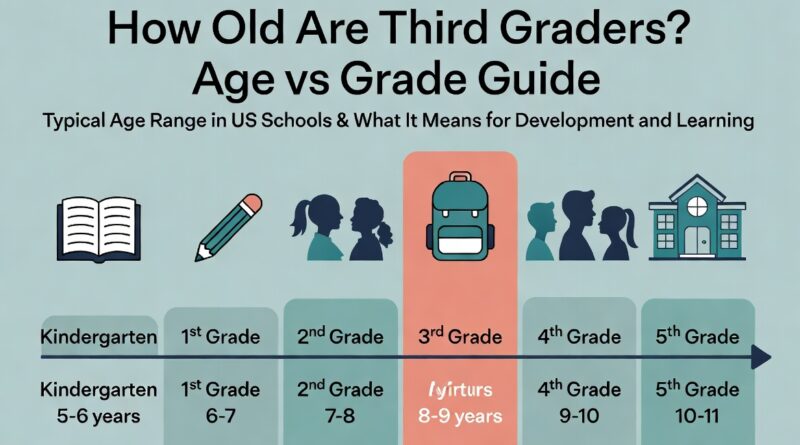
In the United States, third grade students are most commonly 8 to 9 years old. This range appears consistently across educational resources and reflects the standard progression through the K-12 system.
Here is the standard age-to-grade progression for elementary school:
| Grade Level | Typical Age Range |
|---|---|
| Kindergarten | 5–6 years |
| 1st Grade | 6–7 years |
| 2nd Grade | 7–8 years |
| 3rd Grade | 8–9 years |
| 4th Grade | 9–10 years |
| 5th Grade | 10–11 years |
These ages are measured at the start of the school year or during it, which is why you’ll see an overlap (a child might turn 9 midway through third grade). Third grade represents the midpoint of elementary school for most students and is often when statewide standardized testing begins in earnest.

How State Laws and Birthday Cutoff Dates Shape Age in Grade
Grade placement is not determined solely by a child’s birthday — it is heavily influenced by state and district kindergarten entry cutoff dates. Most states require children to turn 5 on or before a specific date (commonly September 1, August 31, or October 1) to begin kindergarten that fall.
Because third grade is three years after kindergarten, these cutoffs create the 8–9 year age window:
- A child born just before the cutoff may start kindergarten at 5 years and 0 months and enter third grade at 8 years and 0 months.
- A child born just after the cutoff may start kindergarten at 5 years and 11 months and enter third grade at 8 years and 11 months (nearly 9).
Examples of common cutoff policies (policies can vary slightly by district and change over time — always verify with your local school):
- Many states (including California, Texas, and others) use September 1.
- Some use August 31 or August 1.
- A few states or districts allow local flexibility or have moved cutoffs earlier in recent years (e.g., recent changes in Ohio).
These small differences in starting age can mean a child is one of the youngest or oldest in their class by third grade. In my experience working with families, this relative age difference often becomes noticeable in third grade as academic and social demands intensify.
Also Read: How Old Are Students in Each Grade? Age-by-Grade Chart
Factors That Can Shift a Child’s Grade Placement
While most children follow the typical 8–9 year path, several situations create exceptions:
- Redshirting (delaying kindergarten entry): Parents may hold a child back a year for maturity, birthdate proximity to cutoff, or perceived readiness. This results in an older third grader (sometimes 9 turning 10).
- Grade retention: A child who repeats a grade will be older than classmates.
- Acceleration or grade skipping: Gifted or advanced learners may enter third grade younger than 8.
- Homeschooling, private schools, or transfers: Placement is often based on assessment rather than strict age.
- Special education or IEPs: Decisions prioritize developmental needs over chronological age.
- Frequent moves (military families, etc.): Mid-year transfers can lead to temporary age/grade mismatches.
Research and classroom observation show that being significantly younger or older than peers can affect confidence, peer relationships, and participation in age-normed activities like sports. There is no universal “best” age — what matters most is whether the child is developmentally ready for the cognitive, social, and emotional expectations of the grade.
Age vs. Grade: Why the Distinction Matters
Grade level reflects curriculum exposure and seat time more than strict developmental stage. Two children in the same third-grade classroom can be at very different points in their cognitive, social, and emotional growth.
Third grade aligns beautifully with the concrete operational stage described by developmental psychologist Jean Piaget (roughly ages 7–11). Children in this stage become better at logical thinking, understanding cause and effect, and seeing others’ perspectives — skills heavily emphasized in third-grade reading comprehension, math problem-solving, and collaborative projects.
However, chronological age does not guarantee readiness. A younger 8-year-old may still be consolidating reading fluency, while an older 9-year-old might be ready for more complex chapter books and multi-step math. Effective teachers differentiate instruction precisely because of this natural variation within one grade level.

What Third Graders Typically Learn
Third grade represents a major academic shift. Students move from foundational skill-building to applying those skills across subjects.
Reading & Language Arts The famous transition from “learning to read” to “reading to learn” happens here. Students read longer chapter books, make inferences, identify main ideas and supporting details, and compare texts. Writing moves toward structured paragraphs, opinion pieces, and narratives with greater detail.
Mathematics Multiplication and division facts, multi-digit addition and subtraction with regrouping, fractions, measurement, and introductory geometry. Word problems require more reasoning and multiple steps.
Science & Social Studies More in-depth exploration of topics like ecosystems, forces and motion, communities, government, and map skills. Students begin conducting simple experiments and research projects.
Social-Emotional & Executive Function Greater emphasis on independence, time management, working cooperatively in groups, and self-advocacy. Many schools introduce more formal homework routines.
These expectations are guided by state standards (often aligned with Common Core in English Language Arts and Math). High-quality classrooms provide scaffolds so both younger and older students within the 8–9 range can succeed.
Also Read: 10 Cheap and Easy Activities for 5 Year Olds
Developmental Milestones for 8- and 9-Year-Olds
Understanding typical milestones helps parents and teachers recognize when a child is thriving or may benefit from additional support. The following draws from developmental frameworks used by educators and specialists.
Physical Development
- Improved coordination, balance, and stamina; can run farther, ride a bike confidently, and participate in organized sports.
- Refining fine motor skills: better pencil grip, legible handwriting, ability to tie shoes and manage zippers/buttons independently.
- Growth spurts common; average gain of 2–4 inches and 4–7 pounds per year.
Cognitive & Academic Development
- Understands cause and effect and reverse operations (e.g., if 6 + 2 = 8, then 8 – 6 = 2).
- Begins planning ahead and organizing thoughts (drawing plans, outlining stories).
- Can sustain attention on interesting tasks for 30–45+ minutes.
- Starts collecting items and developing hobbies with depth.
- Uses complex sentences and experiments with different writing styles.
Language & Literacy
- Moves solidly into reading to learn; vocabulary grows rapidly through reading.
- Enjoys wordplay, jokes, riddles, and puns.
- Can summarize information, express feelings in writing, and discuss books with peers.
Social-Emotional Development
- Increasing peer influence and desire to belong to groups or teams.
- Can take others’ perspectives but still experiences dramatic mood shifts (one minute everything is fine, the next “everyone is against me”).
- Seeks encouragement; self-esteem can be fragile.
- Enjoys sharing secrets and jokes with close friends.
- Wants to behave well but may struggle with consistent attention to directions.
Every child develops at their own pace. Significant delays in multiple areas or sudden regression warrant discussion with teachers and pediatricians.

Supporting Your Third Grader: Practical Tips for Parents and Educators
At Home
- Read together daily — even 15–20 minutes of chapter books builds fluency and comprehension.
- Practice math facts through games rather than drills.
- Encourage independence with routines (homework station, packing backpack the night before).
- Talk about emotions and problem-solve social situations together.
Partnering with School
- Attend parent-teacher conferences prepared with specific questions about academic progress and social development.
- Ask how the teacher differentiates for varying readiness levels within the classroom.
- Request examples of your child’s work to understand expectations.
When Age Feels Like an Issue If your child is among the youngest or oldest, focus on their individual strengths rather than comparisons. Many “young” third graders thrive with strong foundational skills and supportive teachers. Many “older” third graders benefit from leadership roles and enrichment.
International Comparisons
While the U.S. uses “grade” terminology, other countries structure early elementary differently:
- United Kingdom: Year 4 (ages 8–9) — similar content focus.
- Canada: Grade 3 (ages 8–9) — very comparable system.
- Australia: Year 3 or 4 depending on state.
- Some European countries (e.g., Finland) begin formal academics later and emphasize play longer, yet achieve strong outcomes.
These differences remind us that age-grade alignment is culturally constructed. What matters most is whether the environment matches the child’s developmental needs.
Conclusion
Third grade is an exciting, transformative year. While most students are 8 to 9 years old, the real question isn’t just “How old are they?” but “Is this environment helping my child grow academically, socially, and emotionally?”
Focus on your individual child’s strengths, challenges, and developmental pace rather than rigid comparisons. Partner closely with teachers, celebrate progress (not just perfection), and remember that small differences in age within one classroom are normal and manageable with good instruction and support.
Every child deserves to feel capable and valued exactly where they are. With the right information and partnership, you can help your third grader thrive — whether they’re on the younger or older side of 8–9, or somewhere beautifully in between.
FAQs About Third Grade Age and Readiness
Can a 7-year-old be in third grade?
Rarely in traditional public schools, but possible with significant acceleration or in some private/homeschool settings after careful assessment.
What if my child is the youngest or oldest in the class?
Both situations have advantages and challenges. Younger children may need more scaffolding; older children may benefit from leadership opportunities. Individual personality and support matter more than exact age.
How do I know if my child is ready for third grade?
Look at reading fluency, ability to follow multi-step directions, attention span, and social-emotional regulation. Schools conduct assessments; talk with your child’s current teacher.
Does being older or younger affect standardized test scores?
Research on the “relative age effect” shows mixed results. Older students sometimes have slight advantages in the early years, but high-quality instruction and differentiation minimize long-term gaps.
Should I consider holding my child back or having them skip a grade?
These are significant decisions best made collaboratively with educators, using data from assessments, observations, and developmental screenings. There are pros and cons to both.
What resources can help me learn more about third-grade expectations?
Your state department of education website, Understood.org (excellent for learning and development), and your child’s teacher are top starting points. The National Center for Education Statistics (nces.ed.gov) provides valuable data on U.S. education trends.
How has the COVID-19 pandemic affected age and grade norms?
Some students experienced learning disruptions, leading to greater variation in readiness within classrooms. Many schools have increased focus on differentiation and social-emotional support as a result.
Are there specific signs my third grader needs extra support?
Persistent struggles with reading fluency, math facts, following directions, or forming friendships especially if impacting self-esteem merit a conversation with the teacher and possibly a learning specialist.
Do private schools follow the same age guidelines?
Many do, but some have more flexibility for early entry or different cutoff dates. Always ask during the admissions process.
How can I advocate for my child if I feel the grade placement isn’t right?
Document your observations, request a meeting with teachers and administrators, and ask about assessment options or support services. Approach conversations collaboratively.