Accredited Homeschool Programs In Texas for High School
Quick Answer: Texas families seeking accredited high school options for homeschoolers have excellent choices that combine flexibility with recognized credentials. Top options include the University of Texas High School (UTHS) and Texas Tech University K-12 (TTU K-12) — both offering free or low-cost tuition for Texas residents with state or regional accreditation — plus tuition-free public virtual schools like Texas Connections Academy and affordable private options such as Northgate Academy. These programs provide official transcripts, diplomas accepted by colleges and employers, NCAA eligibility where applicable, and AP/dual-credit pathways.
The best fit depends on your priorities: maximum flexibility and low cost (university programs), structured teacher support with public-school resources (virtual academies), or faith-based self-paced learning (private accredited schools). Texas law does not require accreditation for homeschooling, but these programs deliver peace of mind for college admissions, credit transfers, and future transitions. Always verify current details directly with each program, as policies evolve.
Understanding Homeschooling and Accreditation in Texas
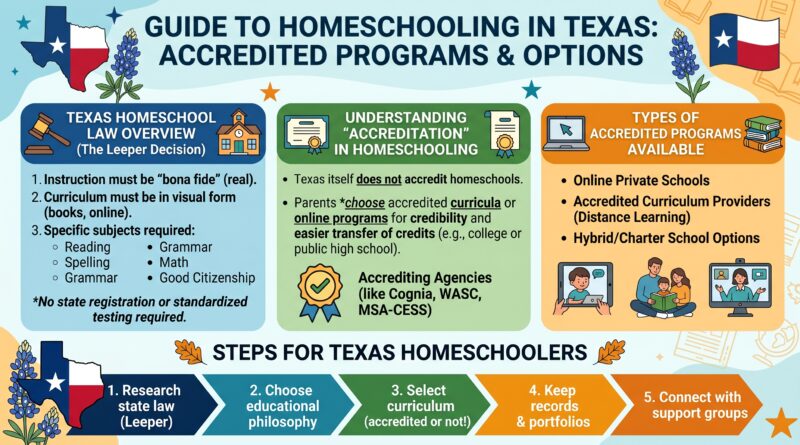
Texas remains one of the most homeschool-friendly states in the U.S. According to the Texas Education Agency (TEA) and the Texas Home School Coalition (THSC), homeschools operate as private schools with minimal regulation. Parents must provide bona fide instruction using a visual (written) curriculum in reading, spelling, grammar, mathematics, and good citizenship. There is no state notification, registration, teacher certification requirement, or mandated standardized testing like STAAR for pure homeschools.
Accreditation applies to schools and programs, not individual curricula. A regionally accredited program (such as those recognized by Cognia) issues transcripts and diplomas that colleges, universities, employers, and the military generally recognize more readily. This is especially valuable for high school students planning college, athletic scholarships (NCAA), or careers requiring verified credentials.
Many Texas families blend approaches: they maintain a parent-directed homeschool core while enrolling in accredited courses or full programs for structure, grading, and official records. This hybrid model satisfies legal requirements while adding institutional credibility.
Why Choose an Accredited Program for High School?
High school is a pivotal time. Accredited programs help in several practical ways:
- Official Transcripts and Diplomas: Simplify college applications and credit transfers if a student returns to traditional school.
- College Preparation: Built-in access to AP courses, dual-credit options through community colleges or universities, and standardized grading that admissions offices understand.
- Flexibility with Accountability: Asynchronous models let student-athletes, performers, or working teens manage schedules while maintaining rigorous academics.
- NCAA and Military Recognition: Many accredited programs have NCAA-approved courses.
- Peace of Mind: Parents gain expert-designed curriculum aligned with Texas Essential Knowledge and Skills (TEKS) or national standards, plus teacher support.
Balanced View: Public virtual options are free but involve more structure and may include some public-school expectations. Private or university programs often feel closer to traditional homeschooling with greater autonomy. Cost, learning style, and long-term goals should guide the decision.
Top Accredited Homeschool Programs in Texas for High School
Here is a detailed look at standout options available to Texas families in 2026.
1. University of Texas High School (UTHS) – University of Texas at Austin
UTHS stands out as a state-accredited online public high school operated by one of Texas’s flagship universities. It explicitly welcomes homeschool families.
Key Features:
- Cost: Free tuition for Texas residents in the full-time Diploma Program. Non-residents pay tuition.
- Format: Fully online and asynchronous — students work at their own pace with Texas-certified teacher facilitation. Open enrollment year-round; start courses anytime with internet access.
- High School Focus: Full diploma pathway or individual courses to supplement a parent-led homeschool. Offers core subjects, honors, AP® courses (College Board audited), and dual-credit opportunities.
- Accreditation & Recognition: State-accredited. Courses are NCAA-approved where applicable.
- Best For: Student-athletes, performers, students needing maximum schedule flexibility, and families wanting a prestigious university-affiliated credential without high cost.
Parent & Student Experience Insights: Families consistently highlight the freedom to balance elite training or work schedules with academics. The asynchronous model reduces daily pressure while teacher support prevents isolation. Many report smoother college transitions because of the UT Austin connection and clear transcripts.
Considerations: As a diploma program, it follows Texas graduation requirements (typically 22–26 credits under the Foundation High School Program with endorsements). Check current credit and assessment details on the UTHS site.
Enrollment Tip: Visit highschool.utexas.edu/homeschool for the Diploma Program or individual course options.
2. Texas Tech University K-12 (TTU K-12)
TTU K-12 delivers another strong university-backed option with deep roots in distance education.
Key Features:
- Cost: Tuition-free for full-time Texas resident students (state-funded). Individual courses approximately $250. Limited spots or lottery systems may apply for free enrollment in some periods.
- Format: Accredited K-12 online program with flexible, independent pacing. Print and online materials available.
- High School Focus: Full Texas high school diploma pathway (26 credits typical). Strong alignment with TEKS. Options for credit by exam and dual credit.
- Accreditation: Cognia-accredited and TEA-approved. Purple Star Campus designation (military-friendly).
- Best For: Families seeking a Texas diploma from a respected public university system, military-connected families, and students who thrive with structured independence.
Experience Note: Parents appreciate the affordability and the direct pathway many students experience toward Texas Tech University admissions. The program supports diverse learners while maintaining high standards.
Considerations: Full-time diploma students follow Texas graduation requirements. Confirm current free-enrollment availability and any assessment expectations.
Enrollment Tip: Start at depts.ttu.edu/k12/. Review tuition-free and paid options.
3. Texas Connections Academy (and Similar Public Virtual Schools)
Texas Connections Academy operates as a tuition-free online public school serving grades 3–12 across Texas (part of a public district framework). Similar K12/Stride-powered options include Texas Virtual Academy at Hallsville and Texas Online Preparatory School.
Key Features:
- Cost: Completely free (publicly funded). Families cover typical supplies or optional activities.
- Format: Blends teacher-led virtual lessons with self-paced work. Certified teachers provide 1:1 support. Parents serve as “Learning Coaches” (typically 1–5 hours/day depending on grade).
- High School Focus: Full diploma, honors, AP®, career/technical education (CTE), dual credit, NCAA-approved courses, and independent study options. In-person graduation ceremonies and field trips available.
- Accreditation: Cognia-accredited with strong outcomes.
- Best For: Families wanting public-school resources, teacher relationships, and extracurricular clubs (including eSports) while learning from home. Strong parent satisfaction scores (often 94%+ in recent surveys).
Experience Note: Many former traditional-school families report that the personalized pacing and caring teacher connections help students who previously struggled with large classrooms. The structure provides accountability without daily commutes.
Considerations: As a public school, students participate in the public education system. This offers benefits like free services but comes with more oversight than pure private homeschooling. Confirm district-specific details.
Enrollment Tip: connectionsacademy.com/texas-virtual-school/. Open enrollment periods for the upcoming school year.
4. Northgate Academy – Private Christian Accredited Option
For families desiring a faith-based environment with full accreditation and homeschool-like flexibility, Northgate Academy (part of Excel Education Systems) is a popular choice.
Key Features:
- Cost: Affordable — approximately $1,690–$1,950 per year or monthly plans around $169/month. Pay-as-you-go options available.
- Format: 100% online, self-paced Christian worldview curriculum with teacher support. Designed for homeschool transfers.
- High School Focus: College-preparatory diploma with standard, AP, and dual-credit courses. Strong emphasis on biblical integration alongside academics.
- Accreditation: Regionally accredited by Cognia (and additional bodies including Middle States Association). Diplomas recognized by colleges, employers, and military.
- Best For: Christian families wanting accredited credentials without high private-school costs, students who prefer self-paced learning, and those seeking a supportive online community.
Experience Note: Parents transferring from pure homeschooling often value the combination of structure, grading support, and faith alignment. The lower cost compared to many traditional private schools makes it accessible.
Considerations: As a private school, it operates outside public-school testing mandates while maintaining rigorous standards.
Enrollment Tip: northgateacademy.com — straightforward online application with homeschool transfer support.
How to Choose the Right Accredited Program
Consider these factors:
- Learning Style & Family Values — Asynchronous university programs suit independent learners. Structured virtual schools work well for students needing daily teacher interaction. Faith-based options like Northgate add worldview alignment.
- College & Career Goals — Prioritize NCAA-approved courses, AP/dual credit access, and strong transcript reputation. UTHS and TTU K-12 carry university prestige.
- Budget & Time Commitment — Public options eliminate tuition but require consistent parent involvement as Learning Coach. Private options cost more but often need less daily oversight.
- Flexibility Needs — Athletes and performers thrive in asynchronous models. Students who benefit from routine may prefer virtual schools with scheduled elements.
- Future Transitions — Accredited transcripts ease re-entry into public school or college applications.
Practical Step: Contact admissions for each shortlist program. Ask about current graduation requirements, sample transcripts, teacher response times, and technology needs. Visit parent forums and Texas homeschool groups for recent experiences.
Practical Tips for Success
- Record-Keeping: Even in accredited programs, maintain your own portfolio of work samples, reading lists, and extracurricular documentation. This strengthens college applications.
- Time Management: Teach students to use planners or digital tools early. Asynchronous programs reward self-discipline.
- Social & Extracurricular Balance: Supplement with local co-ops, sports leagues, volunteer work, or program clubs to build well-rounded applications.
- Mental Health: Watch for isolation in fully online models. Schedule regular family check-ins and in-person activities.
- Hybrid Power: Many successful Texas students take core accredited courses through UTHS or TTU while pursuing passions or dual credit elsewhere.
When families thoughtfully match the program to their child’s personality and goals, outcomes are consistently strong — students gain independence, strong transcripts, and clear paths forward.
Costs and Financial Considerations
Public university and virtual options remove the biggest barrier for most families. Private programs like Northgate remain far more affordable than traditional brick-and-mortar private high schools (often $10k–$20k+ annually). Some families use education savings accounts or scholarships where eligible. Always factor in technology, internet reliability, and any optional fees.
College Preparation and Admissions Reality
Accredited programs strengthen applications, but admissions offices also value homeschool portfolios, essays, test scores (SAT/ACT), recommendations, and demonstrated initiative. Texas homeschoolers from accredited programs regularly gain admission to competitive universities. Dual credit earned during high school can significantly reduce future college costs and time.
Conclusion
Accredited homeschool programs in Texas give families the best of both worlds: the freedom and personalization of homeschooling paired with the credibility and support of established educational institutions. Whether you choose the prestigious, flexible path of UTHS or TTU K-12, the community-oriented structure of Texas Connections Academy, or the faith-integrated affordability of Northgate Academy, these options empower high school students to thrive academically while preparing confidently for college, careers, and life.
The most successful families treat program selection as a thoughtful match to their child’s needs, values, and goals rather than a one-size-fits-all decision. Start by exploring the official websites, talking with admissions counselors, and connecting with other Texas homeschool parents who have walked this path. With the right accredited program, your student can enjoy rigorous academics, meaningful flexibility, and a strong foundation for whatever comes next.
FAQs
Do I legally need an accredited program to homeschool high school in Texas?
No. Texas law treats homeschools as private schools with basic subject requirements. Accreditation is optional but provides valuable credentials.
Will colleges accept a diploma from these programs?
Yes. Regionally or state-accredited programs issue transcripts and diplomas widely recognized by colleges, especially when paired with strong test scores and activities.
Can my child participate in sports or extracurriculars?
Many programs support NCAA eligibility. Local leagues, clubs, and community activities remain open regardless of schooling choice.
What about state testing (STAAR/EOC)?
Pure homeschools are exempt. Public virtual school students may have testing requirements. Private accredited programs generally do not.
How do I handle transcripts if mixing programs?
Accredited programs provide official transcripts. Keep detailed records of any parent-taught or supplemental courses for a complete portfolio.
Are these programs fully online?
Yes, with occasional in-person events (graduations, field trips) at some virtual schools.
Can we switch programs mid-year?
Most allow flexible entry/exit, but check credit transfer policies.
What if my student has special needs?
Many programs offer accommodations and support. Discuss specific needs during enrollment.
How do these compare to doing everything myself?
Parent-led homeschooling offers maximum customization. Accredited programs add structure, expert curriculum, grading, and official records — ideal for families wanting support without full traditional schooling.
Is there financial aid or scholarships?
Public options are free. Some private programs offer payment plans; check for any targeted scholarships.