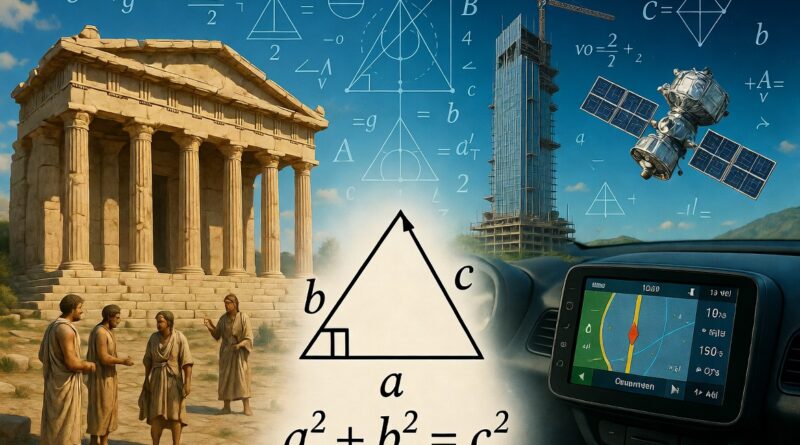
How Did Pythagoras Work In Math Affect Us Today
Quick Answer Pythagoras’ most enduring mathematical contribution—the Pythagorean theorem—continues to shape nearly every aspect of modern life, from the buildings we live and work in to the smartphones in our pockets and the cars we drive. The simple relationship a² + b² = c² for right-angled triangles underpins construction accuracy, navigation systems, computer graphics, robotics, physics calculations, and even music theory. While the underlying idea was known to Babylonian and Indian mathematicians centuries earlier, Pythagoras and his school in ancient Greece helped formalize, prove, and spread this knowledge across the Western world. Today it remains a foundational concept taught to millions of American students and applied daily by engineers, designers, developers, and everyday people solving practical problems. Its elegant simplicity and universal applicability in Euclidean space make it one of the most powerful and lasting ideas in human history.
Last Updated June 18, 2026
Introduction: Why a 2,500-Year-Old Idea Still Matters
Walk into any construction site in the United States, open a mapping app on your phone, or watch a self-driving car navigate city streets, and you are witnessing the living legacy of ancient mathematics. The Pythagorean theorem is not just a dusty formula from middle-school geometry class—it is a practical tool that quietly powers safety, efficiency, innovation, and discovery in the 21st century.
In my experience working with educators, engineers, and content creators who translate complex ideas for general audiences, few mathematical concepts bridge the gap between abstract theory and tangible daily benefit as effectively as this one. When builders check whether a corner is perfectly square, when game developers calculate the exact distance between two characters on screen, or when GPS satellites help you find the fastest route home, they are all relying on principles that trace directly back to the work associated with Pythagoras.
This article explores the depth of that influence. We will examine the historical context with honesty about earlier discoveries, break down the theorem in accessible yet rigorous terms, and dive into specific modern applications across industries. Along the way, you will see real-world examples, practical takeaways you can try yourself, and an honest look at both the theorem’s remarkable strengths and its limitations in our non-Euclidean universe.
Who Was Pythagoras and What Did He Actually Contribute?
Pythagoras of Samos (c. 570–495 BCE) was a Greek philosopher, mathematician, and founder of a influential religious and intellectual community in Croton (southern Italy). His school emphasized that numbers and mathematical relationships reveal the fundamental order of the universe—a worldview that profoundly shaped later Western thought, including Plato and much of early science.
While popular culture credits him with “inventing” the theorem that bears his name, historical evidence tells a more nuanced story. Babylonian clay tablets dating to 1900–1600 BCE already contain Pythagorean triples (sets of three whole numbers that satisfy a² + b² = c², such as 3-4-5) and remarkably accurate approximations of √2. The Indian mathematician Baudhayana described the relationship in the Sulba Sutra around 800–400 BCE. Ancient Egyptians also demonstrated practical knowledge of right triangles in construction.
What sets the Pythagorean school apart is the emphasis on proof and the systematic integration of mathematics into a broader philosophical and educational system. Many scholars believe the first general proof in the Greek tradition emerged from this community, even if the specific proof we commonly teach today comes from Euclid’s Elements (c. 300 BCE). Pythagoras’ group also linked mathematics to music through harmonic ratios, astronomy (the “harmony of the spheres”), and ethics—ideas that influenced education for centuries.
Transparency note: Giving full credit to one individual for a discovery made independently across cultures would be inaccurate. The theorem’s power lies in its repeated independent discovery and its elegant universality, not in single authorship. Pythagoras’ lasting contribution was helping turn scattered practical knowledge into a coherent, teachable, and provable body of mathematics that the Western world adopted and built upon.
Understanding the Pythagorean Theorem
At its core, the theorem states that in any right-angled triangle, the square of the length of the hypotenuse (the side opposite the right angle) equals the sum of the squares of the other two sides. In algebraic form:
a² + b² = c²
Where c is the hypotenuse and a and b are the legs.
A Simple Proof Sketch (Rearrangement Method)
One elegant visual proof involves rearranging four identical right triangles inside a larger square. The space not occupied by the triangles forms two smaller squares whose areas equal a² and b². These together exactly match the area of the square built on the hypotenuse (c²). This rearrangement demonstrates the relationship without heavy algebra and works for any right triangle.
Pythagorean Triples
Whole-number solutions like 3-4-5, 5-12-13, or 8-15-17 are especially useful in construction because they allow builders to create perfect right angles using only a tape measure—no protractor or calculator required.
Practical tip you can try today: To check if a corner is square, measure 3 units along one side and 4 units along the adjacent side. The diagonal between those points should measure exactly 5 units. If it doesn’t, the corner isn’t 90 degrees—adjust until it does. This 3-4-5 method (or multiples like 6-8-10) is used daily on American job sites.
Historical Ripple Effects
Euclid’s formal proof in the Elements turned the theorem into a cornerstone of classical geometry. This work influenced Islamic mathematicians during the Golden Age, who preserved and extended Greek knowledge, and later European Renaissance scholars who rebuilt Western science on those foundations.
The theorem became essential to the development of coordinate geometry (Descartes), calculus, and Newtonian physics. It taught generations of thinkers that the universe operates according to discoverable mathematical laws—an idea central to the Scientific Revolution.
In American education, the Pythagorean theorem is a key standard in 8th-grade mathematics under the Common Core, serving as a gateway to trigonometry, vectors, and more advanced STEM topics. Millions of students each year encounter it, often without realizing how directly it will affect their future careers or daily technologies.
Modern Applications: Where You Encounter Pythagoras Every Day
Architecture, Construction, and Engineering
Every stable building relies on right angles for structural integrity. Architects and engineers use the theorem to calculate diagonals, roof pitches, stair risers, and bracing. When designing a ramp for ADA accessibility compliance, precise slope calculations often involve right-triangle math to balance rise and run safely.
In large-scale projects—skyscrapers, bridges, stadiums—small angular errors compound dramatically. Using Pythagorean calculations (or digital tools built on them) prevents costly rework and ensures safety. Surveyors still employ 3-4-5 techniques or laser equivalents for laying out foundations accurately.
Navigation, GPS, and Transportation
GPS and mapping apps like Google Maps or Apple Maps rely on trilateration: determining your position by measuring distances to multiple satellites. While the full system uses spherical geometry and relativistic corrections, the underlying distance calculations between coordinate points draw directly on Pythagorean principles in local flat approximations and vector differences.
Route optimization—finding the shortest path between two points—frequently reduces to calculating straight-line (“as the crow flies”) distances using the theorem before adjusting for roads. Airlines and shipping companies use similar math for fuel-efficient great-circle routes.
In your car or on your phone, every time the estimated time of arrival updates based on your current location and destination, ancient geometry is helping compute that in real time.
Computer Graphics, Gaming, and Software Development
Video games, animation, and design software constantly calculate distances between objects, detect collisions, and render 3D scenes. The Euclidean distance formula used in virtually every graphics engine is the Pythagorean theorem extended to two or three dimensions:
Distance = √[(x₂ − x₁)² + (y₂ − y₁)² + (z₂ − z₁)²]
Whether you’re playing a first-person shooter, designing a 3D model in Blender, or simply scrolling a responsive website where elements resize cleanly, you are benefiting from this math. Machine learning algorithms (k-nearest neighbors, clustering) also rely heavily on Euclidean distance metrics to group data points or make recommendations.
Physics, Mechanics, and Everyday Forces
When two forces act perpendicular to each other (for example, wind pushing sideways on a moving car while the engine pushes forward), the resultant force is found using the Pythagorean theorem: Resultant = √(Fx² + Fy²).
This principle appears in structural analysis, electrical engineering (impedance calculations in AC circuits), and even simple tasks like determining the true speed of a boat crossing a river with a current.
Music and the Arts
Pythagoras and his followers discovered that harmonious musical intervals correspond to simple whole-number ratios (octave 2:1, perfect fifth 3:2). This mathematical approach to aesthetics influenced Western music theory for over two millennia and remains relevant in digital audio workstations and instrument design today.
Emerging Technologies: LIDAR, Autonomous Vehicles, and More
Modern systems like LIDAR in self-driving cars and archaeological scanning use triangulation and 3D coordinate calculations rooted in the same geometry. Precise distance and angle measurements enable mapping of environments in real time—whether for a robot vacuum learning your living room layout or a drone surveying farmland.
Real-Life Case Studies and Practical Examples
Case 1: Backyard Deck Construction A homeowner in the American Midwest wants to build a rectangular deck 12 feet by 16 feet. Using the 3-4-5 scaled method (multiply by 4: 12-16-20), they verify the corners are square before pouring concrete footings. This simple check prevents the entire structure from being out of plumb, saving thousands in potential corrections later.
Case 2: App Development A mobile developer building a fitness tracking app needs to calculate the straight-line distance a user ran across a park (ignoring paths). Implementing the Euclidean distance formula gives accurate “as the crow flies” metrics that users expect, even though the actual run followed sidewalks.
Case 3: Professional Surveying Land surveyors in rapidly growing Sun Belt cities use total stations and GPS rovers whose internal calculations rest on coordinate geometry derived from Pythagorean relationships. Accurate property boundaries depend on it—errors of inches can lead to expensive legal disputes.
These examples show the theorem moving fluidly from classroom to job site to software to consumer device.
Limitations and Honest Perspective
The Pythagorean theorem is extraordinarily powerful in flat, Euclidean space—the kind humans experience at human scales. However, it is an approximation when applied to very large distances (Earth’s curvature), very high speeds (special relativity), or strong gravitational fields (general relativity). In Einstein’s spacetime, the interval between events uses a modified version with a minus sign (Minkowski metric), yet the underlying geometric intuition remains influential.
Computers and calculators have not made the theorem obsolete; they have made its applications faster and more precise while still depending on the same mathematical foundation. Understanding the “why” behind the calculations helps professionals debug problems, innovate new uses, and teach the next generation effectively.
Conclusion
Pythagoras did not single-handedly invent the theorem that bears his name, yet his school’s work in formalizing, proving, and teaching it helped transform scattered practical insights into a coherent intellectual tradition that still drives progress today. From ensuring a backyard deck is level to enabling the complex calculations behind autonomous vehicles and global navigation, this elegant relationship between sides of a right triangle demonstrates the timeless value of mathematical insight.
The next time you take a shortcut across a park, watch a movie rendered in 3D, or trust your phone to guide you accurately through an unfamiliar city, remember: you are experiencing the direct, living impact of ideas refined more than two millennia ago. Math is not separate from life it is woven into the fabric of how we build, move, create, and understand our world.
Appreciate it. Use it. And perhaps share its story with the next generation of problem-solvers.
FAQs
Was Pythagoras the first person to discover the theorem?
No. Babylonian mathematicians documented Pythagorean triples over a thousand years earlier, and Indian texts also contain the relationship. Pythagoras’ school is credited with developing and spreading a proof and embedding it within a broader mathematical-philosophical system in the Greek tradition.
How is the Pythagorean theorem used in GPS?
GPS determines your position through trilateration—calculating distances from multiple satellites. While the global system accounts for curvature and relativity, local distance and coordinate calculations rely on Pythagorean geometry to translate time-of-flight measurements into precise latitude, longitude, and elevation.
Can I use it for something practical at home right now?
Yes. Use the 3-4-5 method to check if picture frames, shelves, or garden beds have true right angles. Or calculate the exact length of a diagonal brace needed for a gate or bookshelf.
Does it only work in two dimensions?
The core idea extends naturally to three (and higher) dimensions as the Euclidean distance formula. This is why it powers 3D graphics, robotics path planning, and spatial audio.
Why do schools still teach it when we have computers?
Understanding the principle builds spatial reasoning, problem-solving skills, and intuition that no black-box app can replace. It also serves as the foundation for trigonometry, vectors, calculus, and data science.
Are there modern geometries where it doesn’t apply?
Yes. On curved surfaces (non-Euclidean geometry) or at relativistic speeds, modified versions are needed. However, for virtually all human-scale engineering, architecture, and software, the classical theorem remains accurate and indispensable.
How has it influenced fields beyond pure math?
It shaped Western philosophy’s view of a mathematically ordered universe, influenced music theory through harmonic ratios, and provided the geometric backbone for physics and engineering that built the modern technological world.