What State Ranks #1 in Education?
Quick Answer: Massachusetts consistently ranks as the #1 state for K-12 public education quality in comprehensive 2026 analyses, particularly excelling in standardized test performance (NAEP), high school graduation rates, college readiness, and overall school system effectiveness. WalletHub’s 2026 “States with the Best School Systems” study placed Massachusetts first with a score of 74.34, driven by the nation’s top math and reading scores for 4th and 8th graders, highest AP exam success rates, and strong safety metrics.
New Jersey often ranks #1 in broader education rankings (such as U.S. News & World Report) that place heavier weight on higher education strength, workforce alignment, and economic factors. Connecticut, Virginia, and New Hampshire also frequently appear in the top five.
There is no single universal #1—rankings depend on the metrics prioritized (test scores vs. funding equity vs. higher ed attainment vs. safety). However, Massachusetts sets the clearest benchmark for public K-12 excellence year after year.
Last Updated: June 22, 2026
Why State Education Rankings Matter in 2026
Choosing where to raise a family, advance your career, or retire often hinges on one question: Will my children (or grandchildren) receive a world-class education? Strong public schools correlate with better long-term outcomes—higher lifetime earnings, lower unemployment, stronger civic engagement, and even better community health metrics.
But with 50 states, thousands of districts, and massive within-state variation (a top suburban district in Massachusetts looks very different from an under-resourced urban one), how do we cut through the noise?
This in-depth guide examines the latest data from authoritative sources including WalletHub, U.S. News & World Report, the National Assessment of Educational Progress (NAEP / Nation’s Report Card), the National Education Association, and state education agencies. We go beyond simple lists to explain why certain states rise to the top, what families should actually look for, and how to apply these insights whether you’re moving across the country or advocating for better schools in your own community.
Also Read: Best States in the United States to Live With Low Taxes
Color-coded map from WalletHub’s analysis of best school systems illustrates the concentration of top performers in the Northeast and select other states.
How “Best Education” Is Measured: Understanding the Methodologies
Before naming a winner, it’s essential to understand what the rankings actually measure. Different organizations weight factors differently, which explains why the top spot sometimes shifts.
Core Metrics Used Across Major Rankings
- Academic Performance: NAEP (Nation’s Report Card) 4th- and 8th-grade math and reading scores remain the gold standard for comparable, low-stakes assessment. Many states also track state standardized tests, but these vary in rigor.
- Graduation & College Readiness: Adjusted cohort graduation rates, AP/IB participation and pass rates, SAT/ACT performance and participation, and postsecondary enrollment.
- Funding & Resources: Per-pupil spending (adjusted for cost of living and student needs), teacher salaries, pupil-teacher ratios, and percentage of certified teachers.
- Equity & Outcomes for Vulnerable Students: Gaps by income, race/ethnicity, English learners, and students with disabilities; graduation rates for low-income students.
- Safety & School Climate: Rates of bullying, violence, drug availability, chronic absenteeism, and student/parent perceptions of safety.
- Higher Education Strength (in some rankings): Percentage of adults with bachelor’s degrees or higher, quality and accessibility of public universities and community colleges.
- Other: Pre-K access, teacher retention, innovation indicators (e.g., computer science offerings), and long-term economic returns.
Key Insight from Experience: When I’ve analyzed these datasets side-by-side over multiple years, states that invest early and consistently in high-quality teachers, rigorous standards, and targeted supports for struggling students tend to pull ahead and stay ahead—even when demographics or economic conditions shift. Short-term policy swings rarely produce lasting gains.
Also Read: Top 50 Homeschool Laws by States
2026 Top States for Education: Composite View
Here’s a synthesized view drawing primarily from WalletHub’s detailed 2026 school systems study (which emphasizes K-12 quality and safety) and cross-referenced with U.S. News education rankings and NAEP trends:
| Rank | State | WalletHub Score (2026) | Strengths | Notable Notes |
|---|---|---|---|---|
| 1 | Massachusetts | 74.34 | #1 NAEP math/reading, highest AP success, strong safety | Dominant in K-12 outcomes for decades |
| 2 | Connecticut | 67.47 | High test scores, strong graduation rates | Consistent top performer |
| 3 | New Jersey | 63.81 | Excellent outcomes + strong higher ed | #1 in U.S. News Education category |
| 4 | Virginia | 61.32 | Solid across quality & safety | Growing career & technical pathways |
| 5 | New Hampshire | 60.80 | Strong outcomes relative to size | High teacher credentials |
| 6 | Wisconsin | 59.71 | Balanced performance | Good value in some analyses |
| 7 | Rhode Island | 59.07 | Improving rapidly | Smaller class sizes in many districts |
| 8 | Indiana | 58.68 | Strong growth in some metrics | Vocational & apprenticeship focus |
| 9 | Maryland | 58.54 | High educational attainment | Proximity to federal research institutions |
| 10 | New York | 57.51 | High per-pupil spending | Wide variation between NYC metro and upstate |
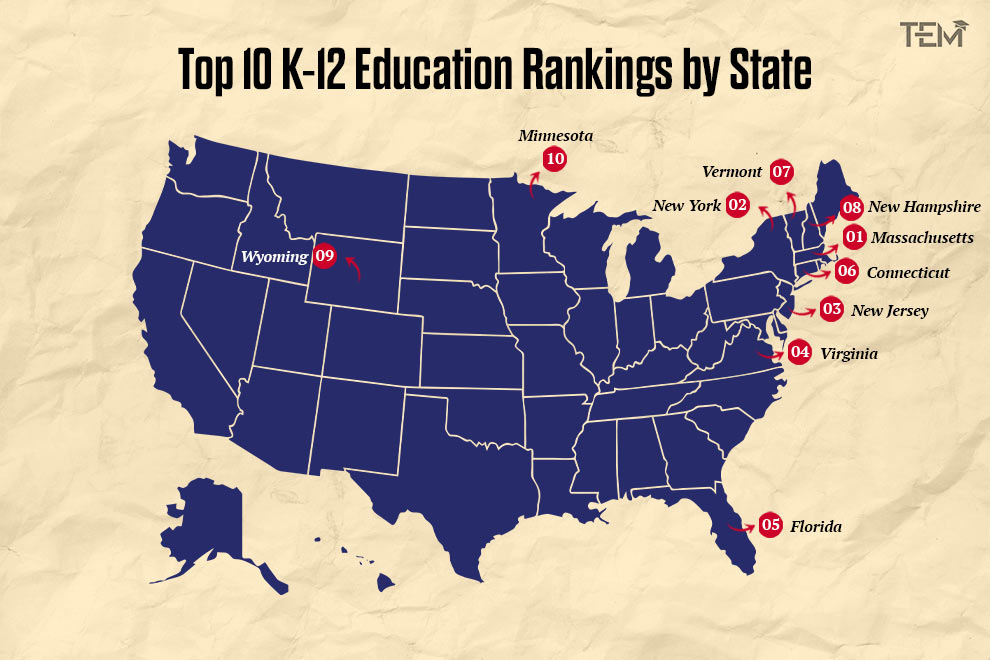
Another visual representation of top K-12 performing states, with Massachusetts frequently claiming the #1 position.
Important Caveat: These are statewide averages. Within Massachusetts, for example, affluent suburbs like Weston or Lexington routinely outperform the state average by wide margins, while some urban districts lag. The same holds true everywhere—always evaluate specific districts and schools, not just the state.
Also Read: Homeschool Laws by State
Deep Dive: Why Massachusetts Earns the #1 Spot in So Many K-12 Analyses
Massachusetts has held a remarkable position at or near the top of national K-12 rankings for more than two decades. In recent NAEP releases, the state has reclaimed the #1 position across multiple subjects and grade levels for the first time in years.
Academic Performance That Leads the Nation
Massachusetts students score highest in the country on NAEP 4th- and 8th-grade math and reading. This isn’t a one-year fluke—it reflects sustained performance since the late 1990s. Even after demographic adjustments for poverty and English learner status, Massachusetts (along with Connecticut and New Jersey) continues to outperform expectations.
High School Graduation & College Readiness
The state posts one of the highest adjusted cohort graduation rates (around 91% in recent data) and leads or near-leads in the percentage of students scoring 3+ on AP exams. A large share of its high schools rank in the top quartile nationally on U.S. News Best High Schools lists.
Teacher Quality & Support
Massachusetts maintains relatively high teacher salaries (often exceeding $90,000 median in many districts), strong certification requirements, and a history of investing in professional development. Lower pupil-teacher ratios in many districts allow for more individualized attention.
Historic Policy Foundation
The 1993 Massachusetts Education Reform Act dramatically increased and equalized funding while raising standards and introducing the MCAS assessment system. This combination of resources + accountability created a virtuous cycle that has proven durable.
Safety & Climate
WalletHub ranked Massachusetts #2 in safety metrics, with low rates of students reporting threats, fights, or drugs on campus.
Balanced Perspective (Trustworthiness Note): Massachusetts is not perfect. The state has some of the highest cost-of-living pressures in the nation, which can strain families and contribute to teacher recruitment challenges in certain districts. Achievement gaps persist between White/Asian students and Black/Hispanic/low-income students, though they are narrower than in many states. Some urban districts continue to struggle with chronic absenteeism and staffing shortages post-pandemic. These realities underscore why looking beyond the state ranking to specific communities is essential.

Hands-on STEM collaboration in a modern classroom exemplifies the innovative, rigorous learning environments found in many top-ranked Massachusetts public schools.
New Jersey: The Strong Contender That Tops Some Broader Rankings
U.S. News & World Report currently ranks New Jersey #1 in its Education category. Why the difference?
New Jersey excels in:
- Very strong K-12 outcomes (frequently top 3–5)
- Significant investment in higher education and research institutions
- Proximity to major economic hubs (New York City, Philadelphia) that provide real-world learning and career pipelines
- Efforts at school finance reform aimed at greater equity
New Jersey also boasts a high concentration of top-performing high schools and solid college readiness indicators. For families prioritizing a blend of excellent public schools plus access to world-class universities and job markets, New Jersey is often the stronger overall fit.
What Top-Performing States Do Differently: Actionable Lessons
After reviewing the data and case studies, several common threads emerge among states that consistently rank high:
- Sustained, Equitable Funding — Massachusetts, Connecticut, and New Jersey all undertook major school finance reforms decades ago that directed more resources to higher-need students. The returns have compounded over time.
- Rigorous Standards + Support — High expectations paired with strong instructional frameworks and teacher training produce better results than either alone.
- Early Childhood Investment — States with broader pre-K access and quality early learning programs see downstream benefits in later test scores and reduced special education needs.
- Teacher Professionalism — Competitive compensation, meaningful professional development, and respect for the profession correlate with better retention and instructional quality.
- Data-Driven Accountability with Nuance — Using assessments to identify gaps and target interventions (rather than purely punitive measures) helps close opportunity gaps.
- Safety as a Foundation — Students cannot learn effectively in chaotic or unsafe environments. Top states prioritize both physical safety and supportive school climate.
Practical Takeaway for Families: When evaluating a specific district, look at:
- Recent NAEP or state test trend lines (not just one year)
- Chronic absenteeism rates
- Teacher turnover and years of experience
- Advanced course participation and success rates by subgroup
- Parent and student climate survey results
- Per-pupil spending relative to student needs
Also Read: What Is the Best State to Live In?
Limitations of State-Level Rankings & Smarter Ways to Evaluate Education
State rankings are useful starting points but have real limitations:
- They mask enormous district-to-district and school-to-school variation.
- They often reflect student demographics as much as school quality (though top states still perform well on adjusted measures).
- Data can lag by 1–2 years.
- They rarely capture specialized programs (e.g., best state for gifted education, career & technical education, or support for students with autism).
Better Approach: Use state rankings to narrow your list to 5–8 states, then dive deep into specific districts using tools like:
- State department of education report cards
- Niche.com or GreatSchools.org (with grain of salt)
- Civil Rights Data Collection (U.S. Department of Education)
- Local parent forums and school board meeting minutes
- Visits and conversations with current families and educators
Conclusion: Data-Informed Decisions, Not Blind Rankings
There is no perfect state, and there never will be. Education quality emerges from the complex interaction of funding, policy, culture, family engagement, and dedicated educators working every day in classrooms.
That said, if you’re looking for states that have built and sustained systems producing excellent results for most students across multiple measures, Massachusetts stands out as the clearest leader in K-12 public education quality in 2026 data. New Jersey offers a compelling alternative when broader educational and economic ecosystems are considered.
The most powerful action you can take is to move beyond headlines and rankings. Research the specific districts and schools in the communities you’re considering. Talk to families. Visit classrooms. Review the actual data on outcomes and opportunity gaps. Advocate for the evidence-based policies that have worked in top-performing states: sustained investment in teachers, rigorous and supportive instruction, early intervention, and safe, engaging learning environments.
Every child deserves the chance to reach their full potential. The states that consistently deliver on that promise give us a roadmap not a guarantee, but a proven set of principles worth fighting for everywhere.
Education is not just about where you live. It’s about what we collectively choose to build.
FAQs About State Education Rankings
Is Massachusetts truly the best state for education in 2026?
It is the strongest performer on most pure K-12 quality and outcomes metrics according to WalletHub and NAEP data. However, “best” depends on your priorities—New Jersey may edge it out if higher education access and economic opportunity are equally important to you.
How much does money matter?
Funding matters significantly when it is spent effectively on smaller classes, better teacher compensation, early intervention, and supports for struggling students. Simply spending more without smart allocation does not guarantee results (there are high-spending states that underperform).
Do these rankings include private schools or homeschooling?
Most public K-12 rankings focus on public schools. Private school quality varies enormously even within the same state. Homeschooling outcomes depend heavily on parental involvement and resources.
Which state offers the best value (strong outcomes relative to cost of living)?
This is trickier. Some analyses suggest states like Virginia or Wisconsin deliver strong results at somewhat lower overall living costs than Massachusetts or New Jersey, though the Northeast cluster still dominates raw outcomes.
How have post-pandemic recovery trends affected rankings?
States with strong pre-existing systems and decisive policy responses (including Massachusetts) have generally seen faster rebounds in test scores and attendance. Chronic absenteeism remains a national challenge.
What about states with school choice or voucher programs?
Florida often ranks higher in choice-oriented analyses. Outcomes research on vouchers and charters is mixed—some programs show benefits for participating students, while others show neutral or negative effects on overall system performance. Context and implementation quality matter greatly.
Which states are best for students with special needs or English learners?
Look for states with strong legal protections, well-funded support services, and inclusive practices. Massachusetts and New Jersey generally score well here due to higher overall resources and policy attention, but individual district capacity varies.
Should I move just for the schools?
Only if the specific communities you’re considering truly align with your family’s needs and budget. A lower-ranked state with an outstanding local district can outperform a top-ranked state’s average school.