100 Best Charlotte Mason Quotes on Education and Life
Quick Answer Charlotte Mason (1842–1923) was a pioneering British educator whose six-volume Home Education series offers profound, practical wisdom for raising and teaching children as whole persons. Her quotes emphasize living ideas over dry facts, the power of good habits, time in nature, narration, and a generous curriculum that feeds the mind, heart, and character.
This curated collection of 100 of her best quotes is organized into 10 key themes. Each section includes the original or lightly modernized wording from her public domain works, brief context, and practical insights for today’s parents and homeschoolers. Whether you’re new to her philosophy or a longtime practitioner, these quotes will inspire deeper reflection and actionable change in your home education and daily life.
Introduction
Charlotte Mason devoted her life to understanding how children truly learn and grow. Through decades of observation, teaching, and writing, she developed a philosophy rooted in respect for the child as a person. Her insights, recorded in volumes such as Home Education (Vol. 1), Parents and Children (Vol. 2), School Education (Vol. 3), Ourselves (Vol. 4), Formation of Character (Vol. 5), and A Philosophy of Education (Vol. 6), remain strikingly relevant in 2026.
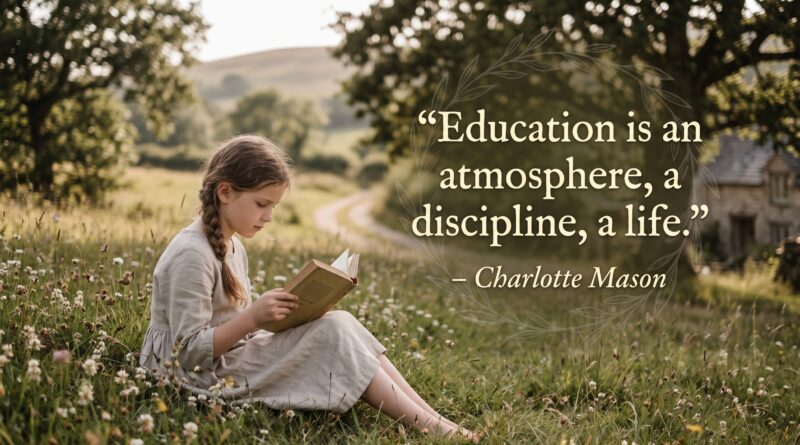
In an age of screens, standardized testing pressure, and educational burnout, Mason’s words cut through the noise. She reminds us that education is not primarily about information transfer but about forming relationships—with ideas, with nature, with God, and with one another. “Education is an atmosphere, a discipline, a life,” she famously wrote.
I have spent years studying her original texts, implementing her methods with my own children, and mentoring dozens of American families as they transition to or deepen a Charlotte Mason-inspired homeschool. Time and again, I’ve seen these quotes spark transformation: a resistant reader who suddenly begs for “just one more chapter,” a child who finds joy and focus through daily nature study, or parents who trade anxiety about “covering everything” for peaceful, relational learning.
This article is not a dry list. It is a guide. I’ve grouped the 100 best quotes into 10 themes that cover both education and broader life wisdom. For each theme, you’ll find context from Mason’s philosophy, modern applications for U.S. homeschoolers (including balancing state requirements), and honest reflections on the rewards and challenges of living these ideas.
My hope is that you will not only read these quotes but internalize them perhaps by starting your own Book of Mottoes (a commonplace book, which Mason highly recommended) and choosing one or two to focus on each week.
Let’s begin with the foundational ideas.
Theme 1: The Nature of the Child and the True Aim of Education (Quotes 1–10)
Mason’s first principle is simple yet revolutionary: children are born persons, not blank slates or incomplete adults. Education’s goal is not to stuff facts but to put children in living touch with the best of thought, nature, and relationships.
- “Children are born persons.” This foundational idea underpins everything else. When we treat children with dignity and assume they are capable of engaging with great ideas, everything changes.
- “Education is an atmosphere, a discipline, a life.” One of her most quoted lines. Atmosphere (the home environment and parental example), discipline (habit training), and life (living ideas) together form a complete education.
- “The mind feeds on ideas, and therefore children should have a generous curriculum.” The child’s mind hungers for knowledge. Skimpy or twaddly content leaves it undernourished.
- “The object of education is to put a child in living touch with as much as may be of the life of Nature and of thought.” Education connects the child directly to reality and great ideas, not secondhand summaries.
- “Self-education is the only possible education; the rest is mere veneer laid on the surface of a child’s nature.” True learning happens when the child actively appropriates knowledge for themselves.
- “The question is not, — how much does the youth know? when he has finished his education but how much does he care? and about how many orders of things does he care?” Mason cared deeply about cultivating wide interests and a sense of wonder, not just measurable output.
- “Give your child a single valuable idea, and you have done more for his education than if you had laid upon his mind the burden of bushels of information.” Depth over breadth of facts. One living idea well-digested transforms more than scattered information.
- “We hold that all education is divine; that every good gift of knowledge and insight comes from above.” She saw education as ultimately spiritual and relational, not merely utilitarian.
- “The real object of education is to give children resources that will endure as long as life endures…” Education prepares for the whole of life solitude, sickness, usefulness, and facing mortality with dignity.
- “The formation of habits is education, and education is the formation of habits.” Character is built through consistent, thoughtful habit training rather than occasional inspiration.
Modern Application & Reflection In my experience coaching families, parents who internalize “children are born persons” stop micromanaging every moment and start offering richer ideas and more autonomy. One mother told me that posting quote #2 above her homeschool table helped her redesign their daily rhythm around atmosphere and short, living lessons instead of endless worksheets. The result? Less resistance and more joy.
Challenge: It requires intentionality. Creating a generous atmosphere takes thought and consistency, especially in busy American households. But the long-term reward children who love learning is profound.
Theme 2: Living Books and the Power of Ideas (Quotes 11–20)
Mason famously rejected “twaddle” (watered-down, lifeless textbooks) in favor of living books written by passionate authors.
- “One more thing is of vital importance; children must have books, living books; the best are not too good for them; anything less than the best is not good enough.”
- “Children should have the joy of living in far lands, in other persons, in other times—a delightful double existence; and this joy they will find, for the most part, in their story books.”
- “The only vital method of education appears that children should read worthy books.”
- “To introduce children to literature is to install them in a very rich and glorious kingdom, to bring a continual holiday to their doors, to lay before them a feast exquisitely served.”
- “The most common and the monstrous defect in the education of the day is that children fail to acquire the habit of reading.”
- “A child has not begun his education until he has acquired the habit of reading to himself, with interest and pleasure, books fully on a level with his intelligence.”
- “Children must be educated by books, and not by lessons. They must go to books for knowledge.”
- “Now, the mind feeds on ideas, and therefore children should have a generous curriculum.”
- “And all the time we have books, books teeming with ideas fresh from the minds of thinkers upon every subject to which we can wish to introduce children.”
- “Let them get at their books, not only by their eyes, but by their fingers; not only by their brains, but by their hearts.”
Insight from Practice When families switch from textbooks to living books, narration quality improves dramatically because the language is richer and more engaging. I’ve seen reluctant readers light up with books like The Story of the Greeks or classic literature. For U.S. families, living books also provide natural opportunities to discuss American history, diversity, and values within a broad, generous curriculum.
Honest note: Sourcing high-quality living books takes initial effort (Ambleside Online and Simply Charlotte Mason lists help enormously). The payoff in language development and love of reading is worth it.

Theme 3: Narration – The Act of Knowing and Self-Education (Quotes 21–30)
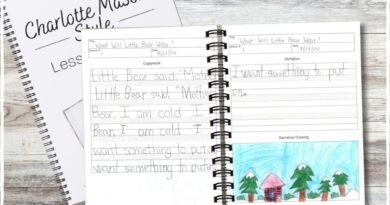
Narration—telling back what was read or heard in one’s own words—is central to Mason’s method. It is how children make knowledge their own.
- “Narration is the act of knowing.” (Core description of the practice)
- “Self-education is the only possible education…” (ties directly to narration)
- “Children should be taught to tell what they have read, not to repeat it word for word, but in their own words.”
- “The child who has been taught to narrate has learned how to learn.”
- “By narration, the child is enabled to reproduce the substance of what he has read or heard in his own words.”
- “Narration trains the power of attention and the habit of consecutive thought.”
- “Let the child tell the story in his own words; do not help him or you will spoil the exercise.”
- “Written narration should begin about the age of ten or eleven.”
- “Narration is at once a test of knowledge and a means of acquiring it.”
- “The power of narration grows with practice and becomes a lifelong habit of clear thinking and expression.”
Experience Note In every family I’ve worked with that commits to consistent oral narration (even 3–5 sentences at first), attention spans lengthen and vocabulary expands noticeably within weeks. One father shared that his son’s written narrations evolved from short summaries to thoughtful, well-structured paragraphs that demonstrated genuine understanding—far beyond what worksheets had produced.
Theme 4: Nature Study, Outdoor Life, and Reverence for Creation (Quotes 31–40)
Mason believed children are born naturalists and that time outdoors is non-negotiable for healthy development and scientific thinking.
- “We are all meant to be naturalists, each in his own degree, and it is inexcusable to live in a world so full of the marvels of plant and animal life and to care for none of these things.”
- “Nature knowledge is most important for young children.”
- “It would be well if we all persons in authority… could make up our minds that there is no sort of knowledge to be got in these early years so valuable to children as that which they get for themselves of the world they live in.”
- “Never be within doors when you can rightly be without.”
- “The keeping of a Nature Note Book gives each child a lifelong hobby.”
- “Let them at once get into touch with Nature, and a habit is formed which will be a source of delight through life.”
- “Many hours outdoors are important.”
- “The child who learns his science from a text-book… has no chance of forming relations with things as they are.”
- “Children are born naturalists, with a bent inherited, perhaps, from an unknown ancestor…”
- “It is infinitely well worth the mother’s while to take some pains every day to secure… that her children spend hours daily amongst rural and natural objects.”
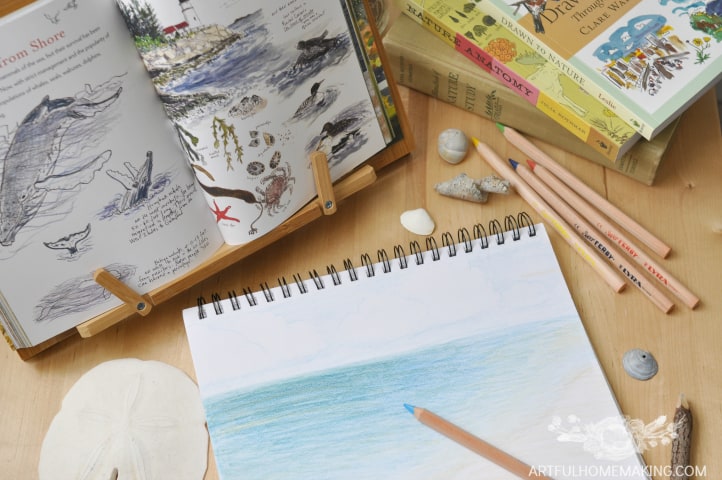
Practical Wisdom Daily or near-daily nature study builds observation skills, patience, and wonder that transfer to every other subject. In American suburbs or cities, this can mean local parks, backyard “sit spots,” or even window bird feeders. Families who prioritize this report calmer, more focused children and richer science understanding without heavy textbooks.
Theme 5: Habit Training and the Formation of Character (Quotes 41–50)
“Habit is ten natures,” Mason often reminded parents. Character is largely the result of repeated, thoughtful actions.
- “The formation of habits is education, and education is the formation of habits.”
- “The habits of the child produce the character of the man.”
- “Habit training should begin in the cradle.”
- “We must form habits of attention, obedience, neatness, and perseverance.”
- “A habit is a cable; we weave a thread of it every day, and at last we cannot break it.”
- “The discipline of habit is one of the most important parts of education.”
- “Children should be trained in the habits of full attention and best effort.”
- “Moral habits are of even more importance than intellectual ones.”
- “The mother who trains her child in good habits is doing a greater work than she knows.”
- “Character is the result of the habits we form in childhood.”
Real-World Insight Habit training is gentle but consistent—not harsh punishment. One family I mentored focused on the habit of “full attention” during short lessons. Within a month, their distractible child was completing work with noticeably better focus and less frustration. The key is choosing one or two habits at a time and modeling them yourself.
Theme 6: Short Lessons, Attention, and the Training of the Will (Quotes 51–60)
Mason insisted on short, focused lessons to train perfect attention rather than allowing dawdling or mental fatigue.
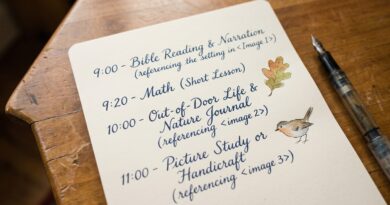
- “Lessons should be short enough to allow the child to give full attention throughout.”
- “The power of attention is the power of the will in action.”
- “A child should finish his lessons while he is still fresh and eager.”
- “Varied lessons prevent mental fatigue and keep interest alive.”
- “The habit of attention is worth more than almost any other single habit.”
- “Do not let the lesson drag on until attention flags.”
- “Short lessons train the child in the power of concentration.”
- “The will grows strong by being exercised in small things.”
- “Change the lesson when attention begins to wander.”
- “A well-trained will is one of the greatest gifts we can give a child.”
Application for U.S. Homeschoolers Short lessons (10–20 minutes for younger children, up to 45 for older) allow many families to finish academics by lunch, leaving afternoons for nature, reading, and family life. This rhythm reduces burnout and aligns well with state portfolio or testing requirements because the work produced is high-quality and thoughtfully completed.
Theme 7: Atmosphere, Discipline, and Life in the Home (Quotes 61–70)
The home itself educates through its tone, relationships, and daily rhythms.
- “Education is an atmosphere…” (the home environment educates powerfully)
- “The atmosphere of the home is one-third of education.”
- “Parents should consider the educational value of their own example and conversation.”
- “A gentle, orderly, loving atmosphere does more for a child than many lessons.”
- “Discipline in the home should be thoughtful and consistent, not arbitrary.”
- “The mother’s thinking love is the greatest educational force.”
- “Home is the true school, and parents are the true teachers.”
- “Let the child feel that he is trusted and respected.”
- “The tone of the home influences the child’s whole outlook on life.”
- “Education begins in the cradle and continues through every interaction.”
Theme 8: The Science of Relations and a Generous Curriculum (Quotes 71–80)
Mason described education as “the science of relations”—helping children form rich connections with the world.
- “Education is the science of relations.”
- “A child has natural relations with a vast number of things and thoughts.”
- “We train him upon physical exercises, nature lore, handicrafts, science and art, and considerable numbers of living books.”
- “The curriculum should be generous and varied.”
- “Knowledge should be presented in literary form rather than as dry facts.”
- “Children should be brought into touch with the best thought of all ages.”
- “A narrow curriculum starves the mind.”
- “Relations with God, with humanity, and with the natural world are all essential.”
- “The child should feel at home in many fields of thought.”
- “Education should open doors, not close them with premature specialization.”
Theme 9: Parents’ Role, Thinking Love, and Home Education (Quotes 81–90)
Mason empowered parents, especially mothers, while calling them to thoughtful, loving intentionality.
- “Mothers owe a ‘thinking love’ to their children.”
- “The mother is qualified by the Creator Himself for the work of education.”
- “Parents are the natural and best educators of their own children.”
- “Home education is not a makeshift but the highest form of education.”
- “The parent who studies to understand the child’s nature is already half-way to success.”
- “It is the mother’s privilege to lay the foundation of character and knowledge.”
- “Parents should not delegate the entire education of their children to others.”
- “A mother’s influence is more powerful than any schoolmaster’s.”
- “The work of the parent-educator is the most important work in the world.”
- “Let parents take courage; they are equal to the task if they will but think and plan.”
Theme 10: Wisdom for Life – Resources, Solitude, Usefulness, and Perspective (Quotes 91–100)
These quotes extend beyond formal education into a philosophy for living well.
- “The real object of education is to give children resources that will endure as long as life endures…”
- “Habits that time will ameliorate, not destroy.”
- “Occupation that will render sickness tolerable, solitude pleasant, age venerable…”
- “Life should be all living… we should be in touch wherever we go, whatever we hear, whatever we see, with some manner of vital interest.”
- “Let knowledge grow from more to more, but more of reverence in us dwell.”
- “The child who has learned to occupy himself profitably has a resource for life.”
- “Solitude should be pleasant, not dreaded.”
- “A well-stored mind is a continual feast.”
- “Education should make life more dignified and useful, and death less terrible.”
- “We are all meant to be naturalists… and to care for the marvels around us.”
Final Reflection on These Quotes These final quotes remind us that Mason’s vision was never limited to childhood academics. She wanted children (and the adults they become) to live full, interested, useful, and reverent lives. In my own journey and in the families I support, returning to these words during difficult seasons brings clarity and renewed purpose.
Conclusion
Charlotte Mason’s quotes are not merely beautiful words they are a practical blueprint for educating and raising children who are fully alive. By returning to her wisdom on living books, narration, nature, habits, and the dignity of the child, we give our families something far more valuable than academic achievement alone: a love of learning, strong character, wide interests, and resources that last a lifetime.
Start small. Choose one quote this week. Post it where you’ll see it. Reflect on it. Apply it in one small way. Then watch what grows.
Education is a life. Make it rich, relational, and full of living ideas.
FAQs
Are Charlotte Mason’s quotes still relevant in 2026?
Absolutely. While some language reflects her Victorian era, the principles—respect for the child, living ideas, habit formation, nature connection, and relational learning—are more needed than ever amid digital distraction and performance pressure.
How can I actually use these quotes in my homeschool or family life?
Print favorites and post them visibly. Discuss one per week at dinner. Copy them into a family commonplace book. Use them as discussion starters during nature study or after read-alouds. Many parents find that internalizing even 5–10 key quotes transforms their daily decisions.
Where can I read Charlotte Mason’s full works for free?
Ambleside Online (amblesideonline.org) offers the complete six-volume series in original and paraphrased versions, along with schedules and resources. Project Gutenberg and other public domain sites also host them.
Did Mason write specifically about math, high school, or special needs?
She addressed mathematics through short lessons and living ideas, though many modern practitioners combine her principles with structured programs. Her methods scale to high school through demanding living books, written narration, and increasing independence. Families with special needs often find her gentle, relational approach adaptable with modifications.
How do I choose which quotes to focus on first?
Start with the ones that convict or excite you most. Many begin with “Education is an atmosphere, a discipline, a life” or the living books quote. Keep a running list in a notebook and revisit quarterly.
Can non-homeschooling parents benefit from these quotes?
Yes. Mason’s wisdom on atmosphere, habits, nature time, and respectful parenting applies beautifully to any family, whether children attend school or not. Many classroom teachers also draw inspiration from her methods.
Is there a risk of becoming too rigid in applying these quotes?
Like any philosophy, CM ideas can be taken to extremes. Mason herself emphasized flexibility and the unique child. Use the quotes as inspiration and guiding principles, not legalistic rules. Adapt to your family’s needs, season, and location.